

New residential borrowing inside super has stopped. Existing loans, refinancing and eligible business property are a different story.
Quick answer: The SMSF borrowing ban took effect on 10 August 2026. SMSFs can generally no longer enter new limited recourse borrowing arrangements (LRBAs) to acquire residential property. Existing residential LRBAs are grandfathered, refinancing them remains permissible, and SMSFs can still use LRBAs for property that meets the definition of business real property.
The SMSF borrowing ban has caused more confusion than almost any other 2026 change. We hear the same sentence from trustees every week: ‘I heard I can’t borrow in super anymore.’ That is partly right. But the parts that are still open matter just as much, and getting them wrong can be expensive.
So let’s take it one piece at a time.
What changed, and when
According to the Mortgage and Finance Association of Australia, new rules restricting SMSF borrowing for residential property came into effect on 10 August 2026. A 45-day transition ran from Royal Assent on 26 June 2026.
Under the new rules, SMSFs can generally no longer enter into new LRBAs to acquire residential property. That is the core of the SMSF borrowing ban.
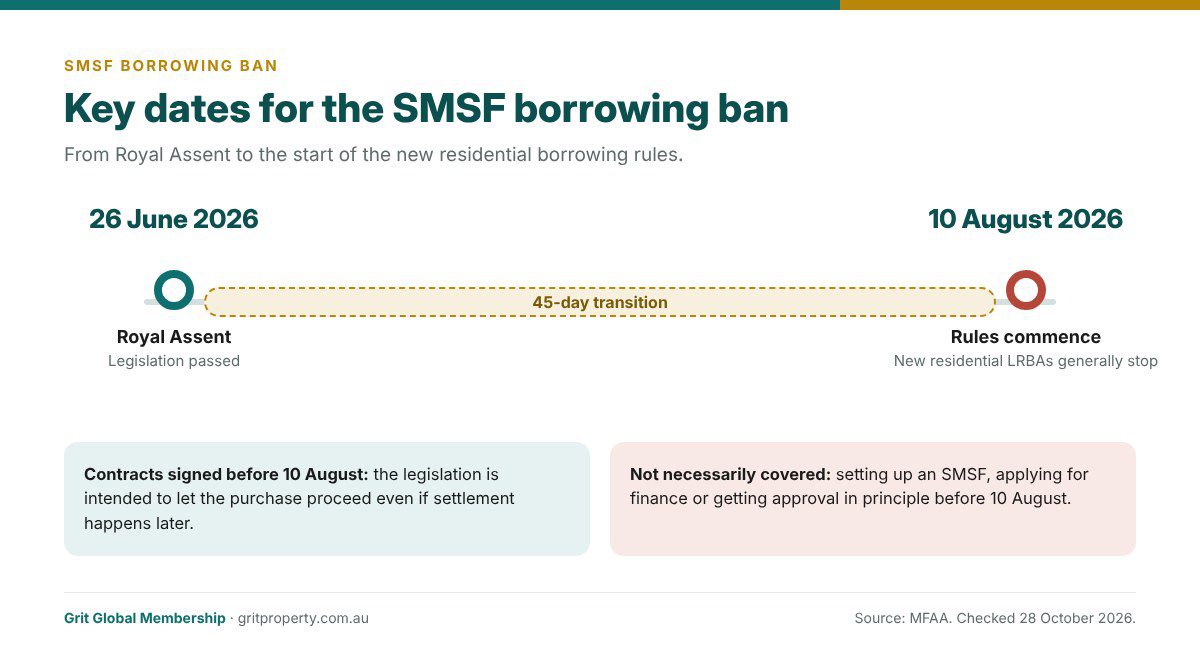
Key dates for the SMSF borrowing ban. Source: MFAA, checked 28 October 2026.
Can my SMSF do this? The five scenarios
Can my SMSF do this?
Scenario
Position after 10 August 2026
Watch out for
New LRBA to buy residential property
Generally no longer permitted
Applies to residential property generally
Existing residential LRBA
Grandfathered; no need to unwind
Keep compliance and documentation current
Refinancing an existing residential LRBA
Remains permissible
Lender policies and appetite vary
Buying residential property with cash (no borrowing)
Still possible within existing super rules
Investment strategy, diversification, liquidity
LRBA for business real property
Still available
Commercial zoning alone does not make a property eligible
Source: MFAA summary of the legislation, checked 28 October 2026. General information only.
What about contracts signed before 10 August?
Where a contract of sale was signed before 10 August 2026, the legislation is intended to allow the purchase to proceed even if settlement happens later. However, the MFAA notes that simply setting up an SMSF, applying for finance or receiving approval in principle before that date does not necessarily mean a deal is covered.
If you are in that grey zone, get specialist advice immediately rather than assuming.
Business real property: open, but read the fine print
SMSFs can continue to use LRBAs to acquire property that meets the definition of business real property. This is where much of the remaining borrowing activity will go.
Here’s the catch. A property being commercially zoned does not automatically make it eligible. Mixed-use properties need careful assessment. So ‘it’s a shop, so it’s fine’ is not a safe assumption.
What did not change: the tax treatment of super
The changes relate to borrowing. They do not alter existing superannuation tax concessions. Income in accumulation phase is generally taxed at up to 15%, and assets held more than 12 months receive a capital gains discount inside the fund. Earnings supporting retirement phase pensions can be tax free, subject to conditions and caps.
Moneysmart has a clear overview of the costs and risks of SMSF property, which is worth reading before any decision.
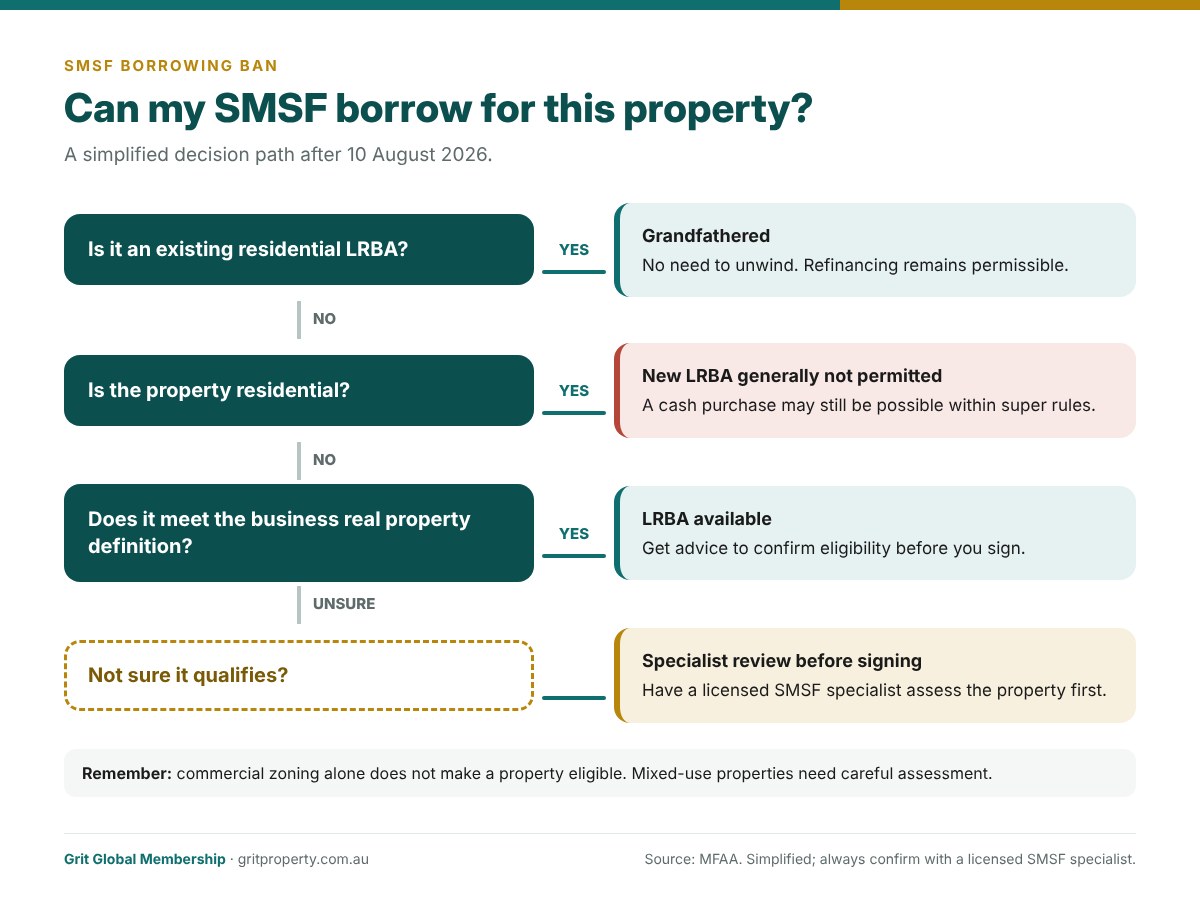
A simplified decision path. Always confirm with a licensed SMSF specialist.
Watch: How to Structure Your Next Investment Property in Australia
The risks of property inside super
- Concentration: one property can dominate a fund.
- Liquidity: property cannot be sold quickly to pay benefits.
- Vacancy: commercial tenants can take months to replace.
- Compliance: the sole purpose test and related party rules are strict, and penalties are serious.
Any borrowing adds to these risks, which is why many specialists favour conservative loan sizes. Your adviser will set limits that suit your fund.
Building outside super at the same time
Remember the SMSF borrowing ban only affects borrowing inside the fund. Outside super, many investors keep building using equity in their home, as explained in How to Use Equity to Buy a Property. The separate rules for personally held property are covered in Negative Gearing in Australia 2026.
A trustee’s story: what changed for one fund
Consider an illustrative couple, Anna and Tom, who planned to use their SMSF to borrow for a townhouse in 2026. Their adviser had the structure ready. Then the SMSF borrowing ban took effect on 10 August, before they’d signed a contract.
Their options narrowed to three: buy residential property with cash if the balance allowed, look at eligible business real property with an LRBA, or keep building the fund and wait. They chose to keep building the fund while their adviser assessed two commercial options. Their personal portfolio kept growing outside super in the meantime.
The lesson isn’t that their choice was right for everyone. It’s that the SMSF borrowing ban changed the menu, not the goal.
What to do if your plans were caught mid-way
- Gather every document: contract dates, finance approvals, fund resolutions.
- Ask your specialist whether your situation falls under the transition rules.
- Review your fund’s investment strategy, since your plans may have changed.
- Consider what the cash earmarked for property should do in the meantime.
Key takeaways
- The SMSF borrowing ban started on 10 August 2026.
- New LRBAs for residential property are generally no longer permitted.
- Existing residential LRBAs are grandfathered and can be refinanced.
- LRBAs remain available for eligible business real property; zoning alone isn’t enough.
- Super’s tax concessions are unchanged.
Frequently asked questions
When did the SMSF borrowing ban start?
On 10 August 2026, after a 45-day transition from Royal Assent on 26 June 2026.
Do I have to sell the residential property my SMSF already owns?
No. Existing residential LRBAs are grandfathered and do not need to be unwound.
Can I refinance my SMSF’s existing property loan?
Refinancing of existing residential LRBAs remains permissible, although lender appetite varies.
Can my SMSF still borrow for commercial property?
It can borrow for property that meets the business real property definition. Commercial zoning alone is not enough.
Can my SMSF still buy a house without borrowing?
Yes, provided it meets existing super rules and the fund’s investment strategy.
Getting the property side right
Your SMSF specialist handles structure and compliance. Grit’s role is finding and assessing the property. Grit Global Membership gives trustees access to private investor deals, including commercial opportunities, plus monthly masterclasses and a one on one portfolio strategy review that looks at your whole position inside and outside super.
General information only. This article summarises the rules in general terms. It is not financial, legal or tax advice. SMSF decisions should be made with a licensed SMSF specialist and your fund’s auditor.
If your fund’s property plans changed in August, a strategy session can help you map the options.
👉 Join the Grit Global Membership and book your free strategy session here