
A plain English guide to the new rules, with the dates that matter and a simple ‘does this apply to me?’ table.
Quick answer: The negative gearing changes limit negative gearing to new builds from 1 July 2027. Properties held at 7:30pm AEST on 12 May 2026 are exempt. Investors who buy established housing after that point can still deduct rental losses against residential property income and carry unused losses forward, but cannot deduct them against wages or other income.
The negative gearing changes are the biggest shift in Australian property tax in a generation, and most of the commentary has been either too alarming or too vague. If you own an investment property, or you are thinking about buying one, you need three things: the actual rule, the dates, and a quick way to see whether it touches you. That is what this guide gives you.
Here is the short version before we go deeper. Most existing investors are not affected at all. The people who need to rethink their numbers are those buying established homes from now on.
What the negative gearing changes actually say
According to the Budget 2026-27 tax reform summary, the Government will ‘limit negative gearing to new builds from 1 July 2027, to focus tax support on new supply’. The ATO confirms these measures are now law.
In practice, that splits investors into three groups.
- Properties held before Budget night: existing arrangements stay unchanged.
- New builds: investors can still deduct losses from other income, such as wages.
- Established housing bought after Budget night: losses can be deducted against residential property income and carried forward, but not against wages or other income.
Notice what the rule does not do. It does not abolish negative gearing. It narrows where the tax benefit applies.
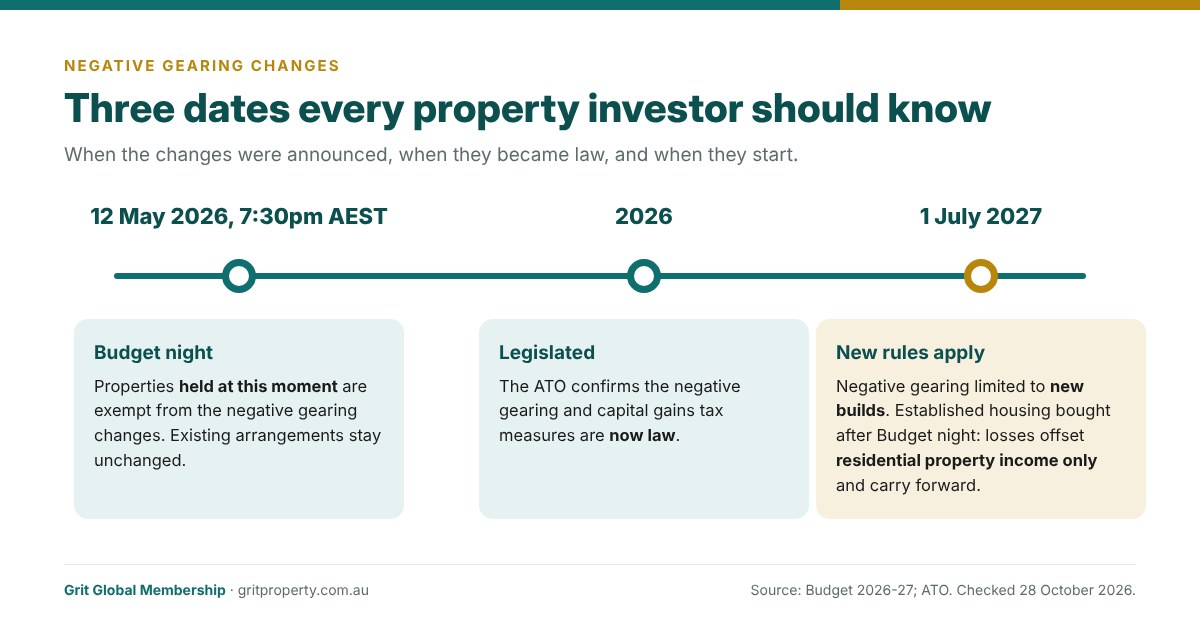
Key dates for the negative gearing changes. Source: Budget 2026-27 and ATO, checked 28 October 2026.
Does this apply to me? A quick check
Does the new rule apply to you?
Your situation
What applies
Next step
You held the property at 7:30pm AEST, 12 May 2026
Existing negative gearing arrangements remain unchanged
Confirm the exact date you acquired it with your accountant
You buy a new build
Losses can still be deducted against other income
Confirm the property meets the ‘new build’ definition in writing
You buy established housing after Budget night
Losses offset residential property income only; unused losses carry forward
Model cash flow without a wage offset
You own property overseas and are an Australian tax resident
Foreign income is generally assessable in Australia; the interaction with these rules needs specialist advice
Speak to a cross-border tax adviser
Source: Budget 2026-27 tax reform summary; ATO tax reform page. General information only.
A worked example, with the assumptions shown
Let’s make this concrete. Meet an illustrative investor we’ll call Sam. Sam earns a salary and is on a 47% marginal tax rate, including the Medicare levy. Sam’s property makes a $25,000 loss in a year after interest, rates, insurance and management.
Under the old rules, that loss reduces Sam’s taxable salary. The tax saving in that year is about $11,750.
Now imagine Sam bought an established property after Budget night and has no other residential property income. From 1 July 2027, that $25,000 loss cannot reduce Sam’s salary tax that year. Instead, it carries forward.
Here is the part many articles skip. The loss is not destroyed. If the property later earns net rental income, or Sam earns other residential property income, the carried forward loss can be used against it. So the change mainly affects timing and cash flow, not whether the loss ever counts.
Illustrative first-year effect (not a forecast)
Old treatment
New treatment (established, bought after Budget night)
Annual rental loss
$25,000
$25,000
Can it reduce salary tax this year?
Yes
No
Tax effect this year at 47%
About $11,750 saving
$0 this year; loss carried forward
Future use of the loss
Already used
Against future residential property income
Source: Grit illustration. Assumes a 47% marginal rate including Medicare levy, no other residential property income, and a constant loss. Excludes rent changes, interest rate changes, depreciation and the time value of money.
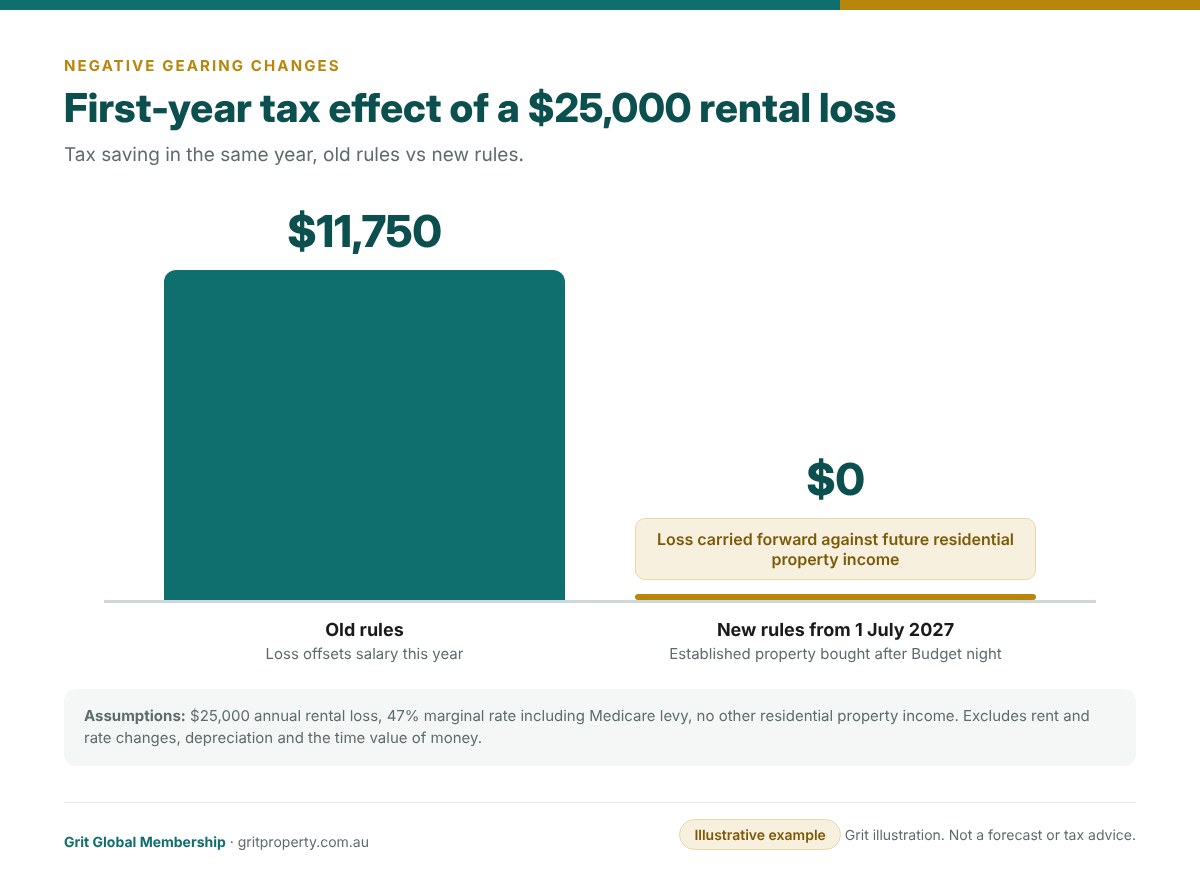
Illustrative first-year tax effect of a $25,000 loss. Assumptions listed in the table above.
Why new builds kept the benefit
The policy logic is about supply. Australia needs more homes, and new construction is the only thing that adds them. So the Government chose to keep tax support for investors who fund new housing.
That creates a gap between new and established property that did not exist before. However, a tax benefit cannot rescue a poor asset. A badly located new build in an oversupplied estate is still a weak investment.
Watch: Australia’s Negative Gearing Changes Explained
This is separate from the capital gains tax change
People often lump the two reforms together, but they work differently. The capital gains tax changes apply to gains that accrue after 1 July 2027, and they are not tied to whether you bought before or after Budget night in the same way.
What sensible investors are doing now
- Owners of exempt properties are reviewing them on their merits rather than selling in a panic.
- Buyers of established property are modelling cash flow with no wage offset from July 2027.
- Buyers comparing new and established property are checking land value, location and builder risk, not just the tax line.
- Investors with overseas income are getting specialist cross-border tax advice.
If you want a refresher on how negative gearing works in the first place, our earlier guide Negative Gearing in Australia 2026 covers the basics. Holding costs such as land tax also change the maths, explained in Land Tax in Australia.
Risks and limits of this guide
- The detailed legislation contains definitions and transition rules that this summary does not cover.
- Your outcome depends on your income, ownership structure and other property income.
- Rules for trusts, companies and SMSFs can differ.
That is why the table above ends with a ‘next step’ column. Use it to frame a conversation with your adviser, not to replace one.
Three common misreadings of the negative gearing changes
Since Budget night, we’ve heard the same three misunderstandings again and again. Clearing them up saves a lot of unnecessary worry.
- ‘I have to sell before 2027.’ No. If you held the property at Budget night, the negative gearing changes don’t touch it while you keep it.
- ‘My losses are gone forever.’ No. For established property bought after Budget night, unused losses carry forward against future residential property income.
- ‘New builds are risk free now.’ No. The tax treatment is better, but builder, location and price risk are unchanged.
If you notice yourself reacting to one of these, pause and check the table earlier in this article.
How the negative gearing changes affect your next purchase
For most investors, the practical effect shows up in the next purchase rather than the current portfolio. An established home bought now needs to make sense on its own cash flow, because the wage offset is no longer there from July 2027. A new build keeps that offset, so its after-tax holding cost can be lower.
That doesn’t automatically make new builds the better buy. It does mean you should compare both options on the same assumptions before deciding, which is exactly what our new build versus established comparison does.
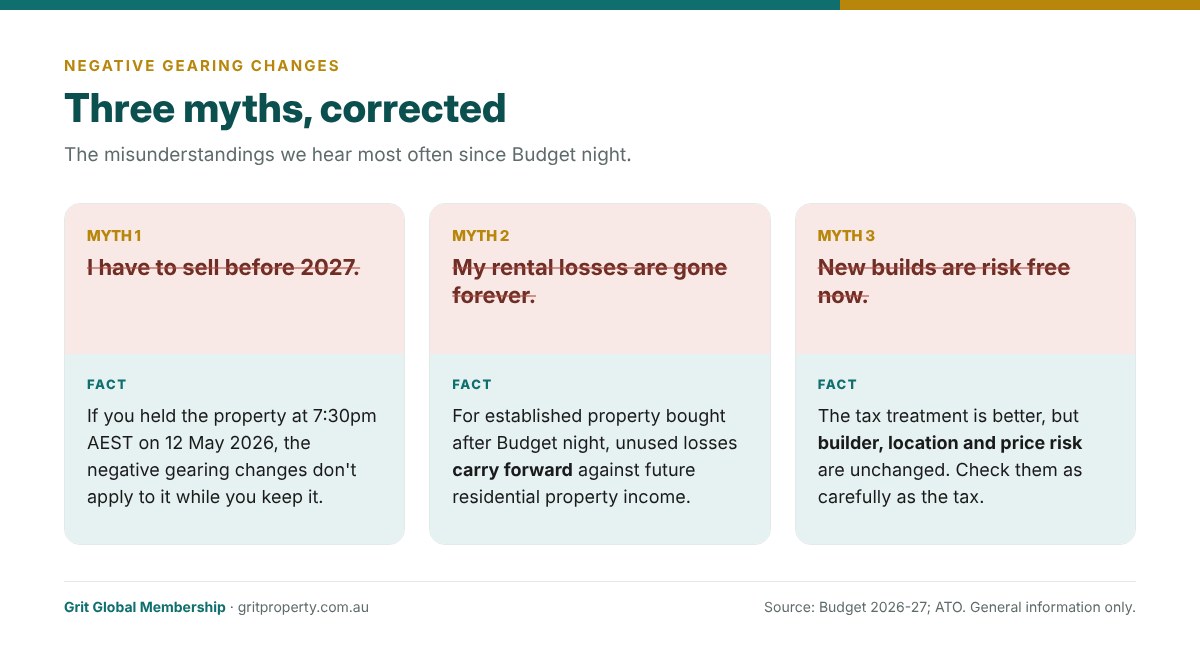
Three myths about the negative gearing changes, corrected.
Key takeaways
- Negative gearing is limited to new builds from 1 July 2027.
- Properties held at 7:30pm AEST on 12 May 2026 are exempt.
- Established housing bought after Budget night: losses offset residential property income only and carry forward.
- The negative gearing changes are separate from the capital gains tax changes.
- Check your own position with a registered tax agent.
Frequently asked questions
Do the negative gearing changes affect property I already own?
Properties held at 7:30pm AEST on 12 May 2026 are exempt from the negative gearing changes, according to the ATO. Confirm your acquisition date with your accountant.
Has negative gearing been abolished?
No. It remains for exempt existing holdings and for new builds. For established housing bought after Budget night, losses can still offset residential property income.
What happens to losses I can’t use?
They carry forward and can be used against future residential property income, according to the Budget summary.
When do the changes start?
From 1 July 2027.
Does this affect my overseas property?
Australian tax residents are generally taxed on worldwide income, so get specialist advice on how foreign rental income interacts with these rules.
Want a second set of eyes on your numbers?
Policy changes reward people who check their own position early. Grit Global Membership includes a one on one portfolio strategy review, monthly masterclasses that unpack rule changes as they land, and access to private investor deals across Australia, Dubai and the United States. Our team works alongside licensed accounting partners, so the tax side is checked by the right people.
General information only. This article explains the announced and legislated measures in general terms. It is not tax, legal or financial advice. Your situation may differ, so speak with a registered tax agent before acting.
If you would like your properties checked against the new rules, start with a free strategy session.
👉 Join the Grit Global Membership and book your free strategy session here
One Response