

The 50% discount is being replaced for gains that accrue after 1 July 2027. Here’s what that means, in plain English.
Quick answer: The capital gains tax changes replace the 50% CGT discount for individuals, trusts and partnerships with a discount based on inflation (cost base indexation) and a minimum 30% tax on capital gains. They only apply to gains that accrue after 1 July 2027. Investors in new builds can choose the 50% discount or the new arrangements.
The capital gains tax changes matter to almost every property investor, not just people buying from now on. That is the single biggest misunderstanding we see. Unlike the negative gearing reform, this change is about when a gain accrues, not when you bought the property.
So if you own property today and plan to hold it beyond mid 2027, keep reading. The way part of your future gain is taxed is changing.
What the capital gains tax changes say
The ATO’s summary of the reform says the 50% discount will be replaced for individuals, trusts and partnerships with cost base indexation and a 30% minimum tax rate on capital gains. It states the reforms ‘will only apply to gains that accrue after 1 July 2027’, and that ‘these measures are now law’.
The Budget summary adds one important carve out: investors in new builds can choose the 50% discount or the new arrangements.
How it differs from the negative gearing change
Two reforms, two different tests
Negative gearing change
Capital gains tax change
Start date
1 July 2027
Gains that accrue after 1 July 2027
What decides if it applies
Whether the property was held at Budget night, and new build or established
When the gain accrues
Existing owners
Exempt for properties held at Budget night
Gains accruing after 1 July 2027 fall under the new rules
New builds
Keep negative gearing against other income
Can choose the 50% discount or the new rules
Source: Budget 2026-27 tax reform summary; ATO tax reform page, checked 28 October 2026.
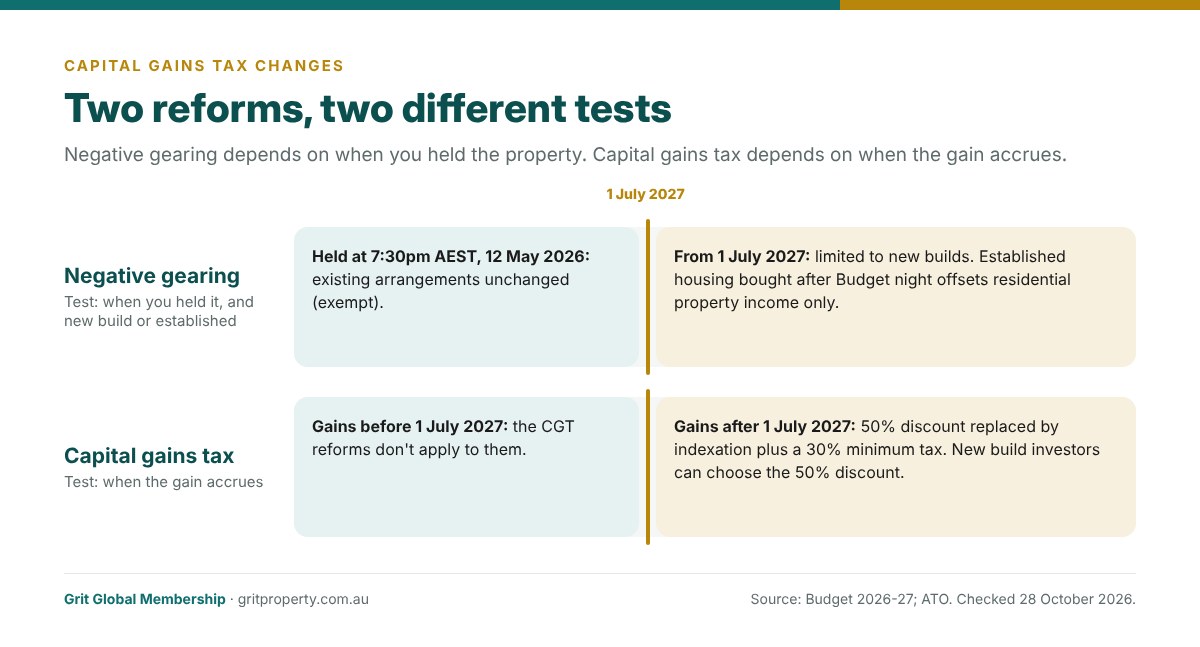
The two reforms use different tests. Source: Budget 2026-27, ATO.
How indexation works, in plain English
Under the old system, you paid tax on half of a long term gain. Under indexation, your cost base is lifted in line with inflation, so you are taxed on the gain above inflation rather than the full nominal gain.
Here’s a simple way to picture it. If you buy something for $100 and inflation over your holding period is 20%, your indexed cost base becomes $120. Sell for $150, and the taxable gain is $30 rather than $50.
Then the second piece applies. The legislation sets a minimum 30% tax rate on capital gains. The exact mechanics of how that minimum interacts with your marginal rate should be confirmed by your tax adviser.
An illustrative example
Take an illustrative investor, Mei, who holds a property with a cost base of $600,000 entirely within the new regime. Assume inflation averages 3% a year for ten years and she sells for $950,000.
Illustrative example: gain accruing entirely after 1 July 2027
Step
Figure
Original cost base
$600,000
Indexed cost base after 10 years at 3% a year
About $806,000
Sale price
$950,000
Nominal gain
$350,000
Indexed (taxable) gain before minimum tax rules
About $144,000
For comparison: 50% discount under old rules
$175,000 taxable
Source: Grit illustration only. Excludes selling costs, capital improvements, the 30% minimum tax calculation and any apportionment for gains before 1 July 2027. Not a tax calculation.
In this example, indexation produces a smaller taxable gain than the old 50% discount. But change the assumptions, with lower inflation or a shorter hold, and the result can flip. That is exactly why individual modelling matters.
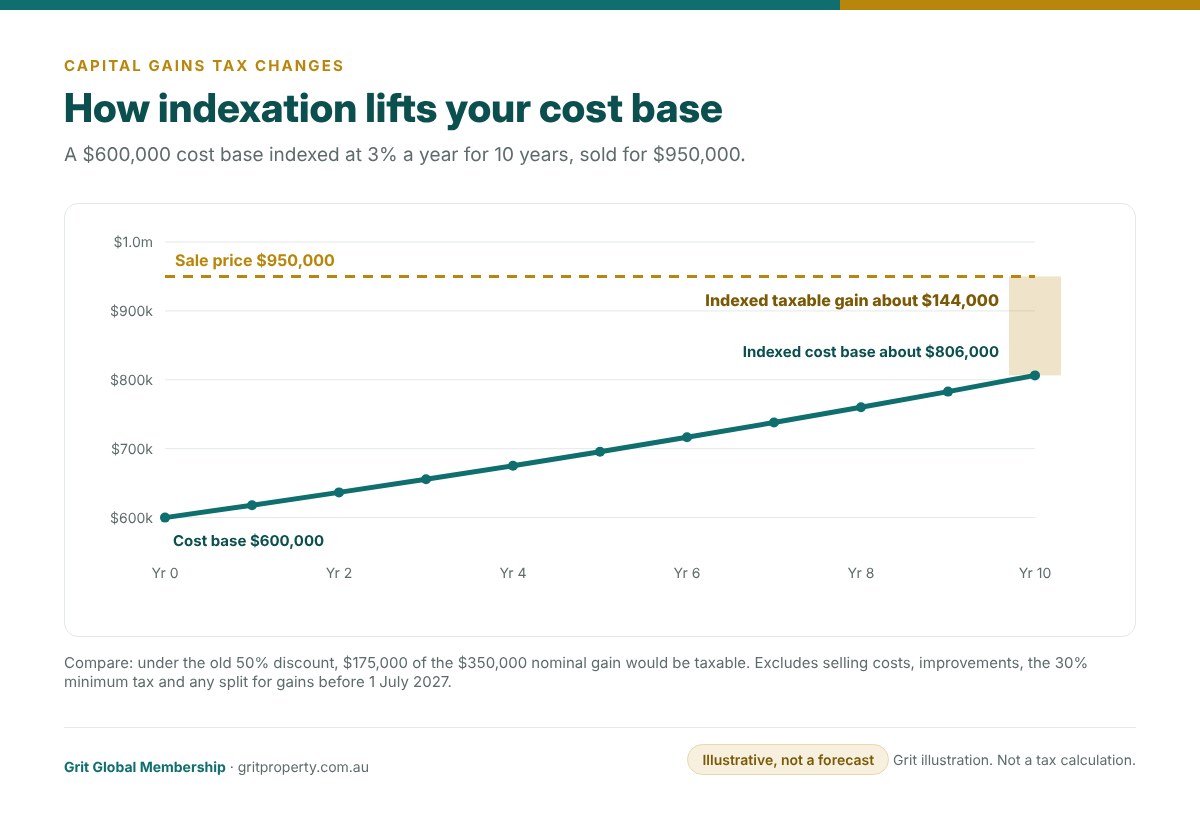
How indexation lifts the cost base over time in the illustrative example.
Who is likely to feel it most
- Investors with short holding periods, where inflation adjustment is small.
- Periods of low inflation, which shrink the indexation benefit.
- Lower and middle income earners, who may be affected by the 30% minimum.
By contrast, long holds with meaningful inflation soften the impact. New build investors also keep a choice. These are general tendencies, not rules, so check them against your own figures.
Watch: How Much Tax Are You Secretly Losing on Your Rental Income?
Practical steps for owners right now
- Gather every document that forms your cost base: contract, stamp duty, legal fees, capital improvements.
- Ask your adviser how gains before and after 1 July 2027 will be measured for your property.
- If you are weighing a sale, model the timing with your adviser rather than reacting to headlines.
- If you are buying, factor the new build choice into your comparison.
Remember that capital gains tax is only one cost of holding property. Land tax also changes your return, as explained in Land Tax in Australia. For the income side, see Negative Gearing in Australia 2026.
Why the capital gains tax changes reward good record keeping
Under indexation, your cost base does more work than it used to. Every legitimate cost you can document, from stamp duty to a new kitchen, forms part of the base that gets indexed. Missing paperwork can mean paying tax on a gain you didn’t really make.
So the simplest response to the capital gains tax changes costs nothing: start a folder for each property today. Contract of sale, settlement statement, stamp duty receipt, legal invoices, every capital improvement invoice and your depreciation schedule.
Questions to take to your tax adviser
- How will the gain on each of my properties be split between before and after 1 July 2027?
- How does the 30% minimum tax interact with my marginal rate?
- For any new build I own or plan to buy, which option is likely to suit me?
- Does my ownership structure (personal, trust, company) change how the capital gains tax changes apply?
Bring these questions and your folder, and the conversation will be far more useful.
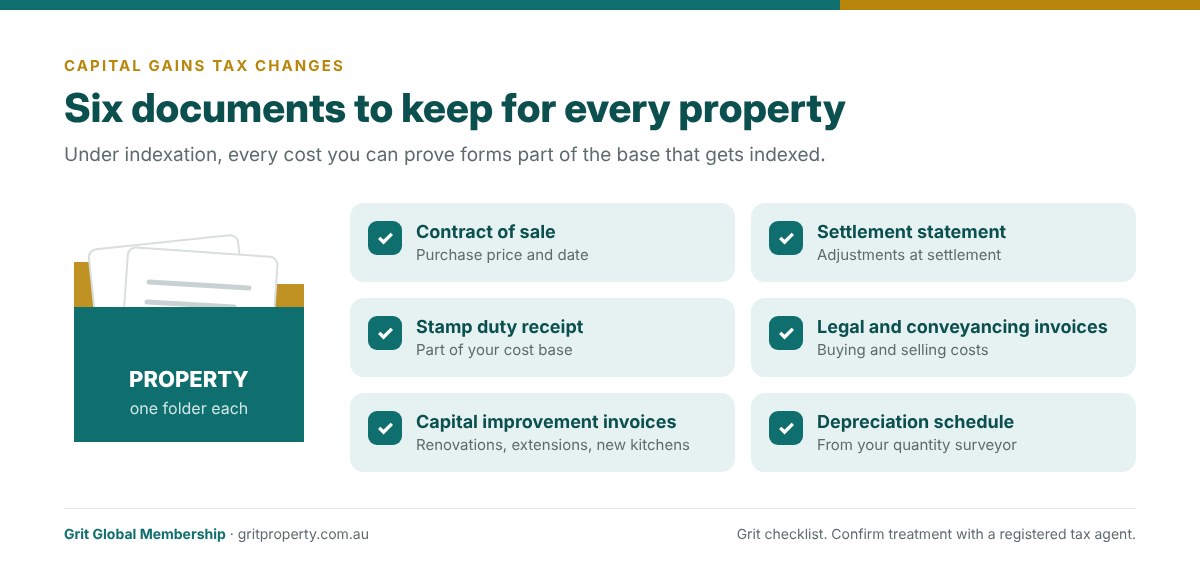
Six documents to keep for every property.
Key takeaways
- The 50% CGT discount is replaced with indexation and a 30% minimum tax.
- The capital gains tax changes apply to gains accruing after 1 July 2027.
- Existing owners can be affected if they hold beyond that date.
- New build investors can choose the 50% discount or the new rules.
- Good records now can reduce tax later.
Frequently asked questions
Do the capital gains tax changes affect property I already own?
They apply to gains that accrue after 1 July 2027, so existing owners who hold beyond that date can be affected. Ask your adviser how your gain will be split.
Is the 50% CGT discount gone completely?
It is replaced for individuals, trusts and partnerships for gains accruing after 1 July 2027. New build investors can choose to keep it.
What is indexation?
It lifts your cost base in line with inflation, so tax applies to the real gain above inflation.
Are these changes law?
The ATO says the measures are now law.
Does this change my home?
The published summaries focus on investors. Confirm how your circumstances are treated with a tax adviser.
Thinking about your exit years in advance
The investors who handle tax changes best usually decide their exit strategy when they buy, not when they sell. Inside Grit Global Membership, the one on one portfolio strategy review looks at holding periods, likely exit points and how new rules affect them, with tax specifics referred to licensed partners. Members also get monthly masterclasses and access to private investor deals across three countries.
General information only. This is a general summary of legislated measures. It is not tax advice and the example is illustrative only. Speak with a registered tax agent about your circumstances.
Planning a purchase or a sale over the next few years? A strategy session is a good place to start.
👉 Join the Grit Global Membership and book your free strategy session here