
Targets, completions, population and rents, with every number dated and the calculation shown.
Quick answer: The Australian housing shortage shows up in the gap between the Housing Accord target of 1.2 million homes over five years (about 240,000 a year) and actual completions. The ABS recorded about 47,700 dwelling completions in the June quarter 2026, an annualised pace of roughly 190,000. Population grew by 392,700 in the year to March 2026, and national asking rents rose 7.3% in a year.
The Australian housing shortage gets quoted in a lot of different numbers, and many of them don't line up because they compare different periods or sources. So in this guide every figure comes with its source and its date, and where we do a calculation, we show it. That way you can check it yourself.
The target
Under the National Housing Accord, governments set a goal of 1.2 million well-located new homes over five years from 1 July 2024. Spread evenly, that's about 240,000 homes a year.
What's actually being built
The latest ABS Building Activity release (June quarter 2026, released 7 October 2026) shows 47,653 dwelling completions in original terms, up 15.8% on a year earlier. About 248,700 dwellings were under construction.
Completions are improving, which is good news. But they are still short of the target pace.
Target versus completions: the calculation
Measure
Figure
Source / method
Housing Accord target
About 240,000 a year
1.2 million over 5 years from 1 July 2024
Completions, June quarter 2026
47,653 (original)
ABS Building Activity, released 7 Oct 2026
Annualised pace (quarter x 4)
About 190,000
Grit calculation; a rough guide only, as quarters vary
Implied annual gap at that pace
About 50,000
240,000 minus about 190,000
Dwellings under construction
About 248,700
ABS, June quarter 2026
Source: ABS Building Activity, June 2026; Grit calculation. Next ABS release: 13 January 2027.
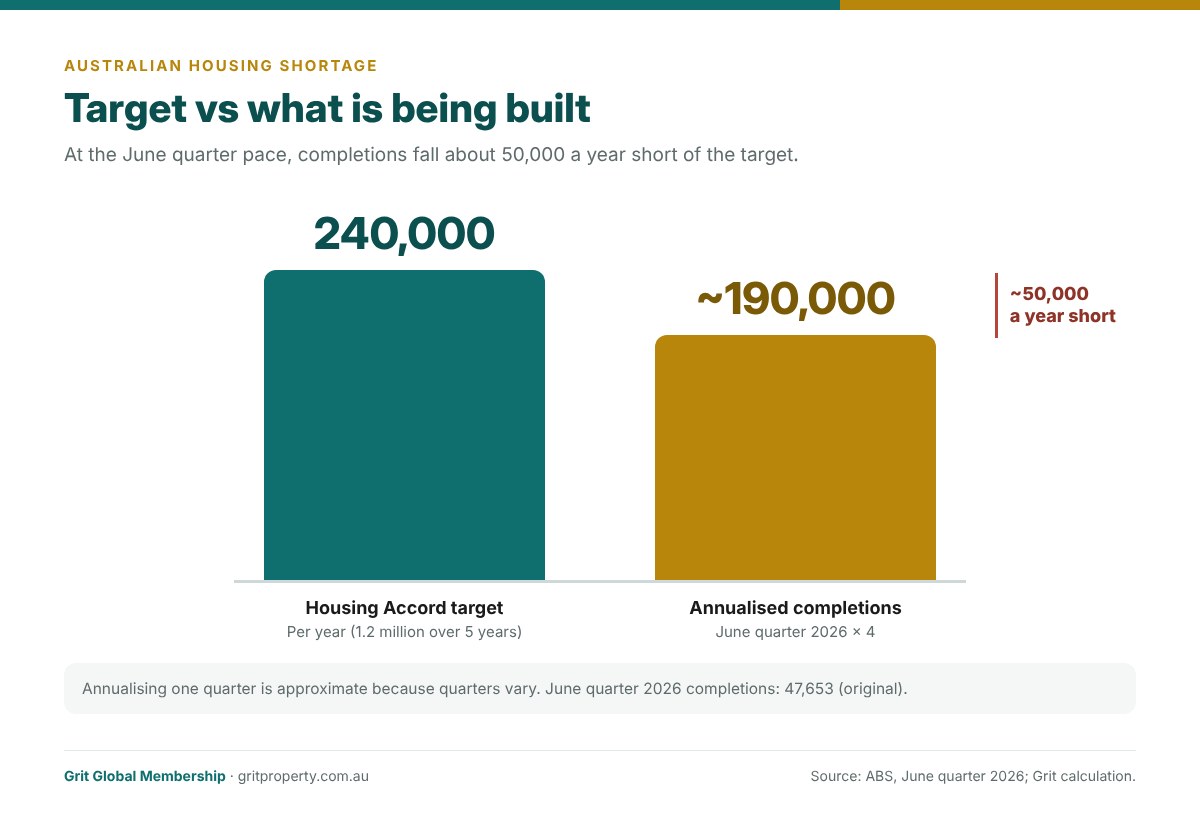
Target versus annualised completions. Source: ABS, June quarter 2026; Grit calculation.
Two cautions. First, annualising a single quarter is approximate. Second, a target gap is not the same as a precise count of 'missing homes', because household formation and where homes are built both matter.
Demand: population growth
The ABS population release for the year to 31 March 2026 shows Australia's population grew by 392,700 (1.4%) to about 27.9 million. Net overseas migration contributed 292,100 and natural increase 100,600.
People don't translate one-for-one into homes, since households vary in size. But sustained population growth with completions below target puts steady pressure on housing, especially rentals.
What it's doing to rents
Asking rents, week ending 28 October 2026
Market
Weekly asking rent
12-month change
National
$709.83
+7.3%
Darwin
$728.62
+12.6%
Hobart
$601.76
+9.4%
Brisbane
$756.64
+7.8%
Melbourne
$688.97
+6.0%
Perth
$798.81
+5.5%
Adelaide
$647.84
+4.1%
Sydney
$917.32
+3.5%
Canberra
$680.69
+2.3%
Source: SQM Research Weekly Rents Index, all dwellings, week ending 28 October 2026.
Asking rents are tracked weekly by SQM Research. Note these are advertised rents, not what every tenant pays.
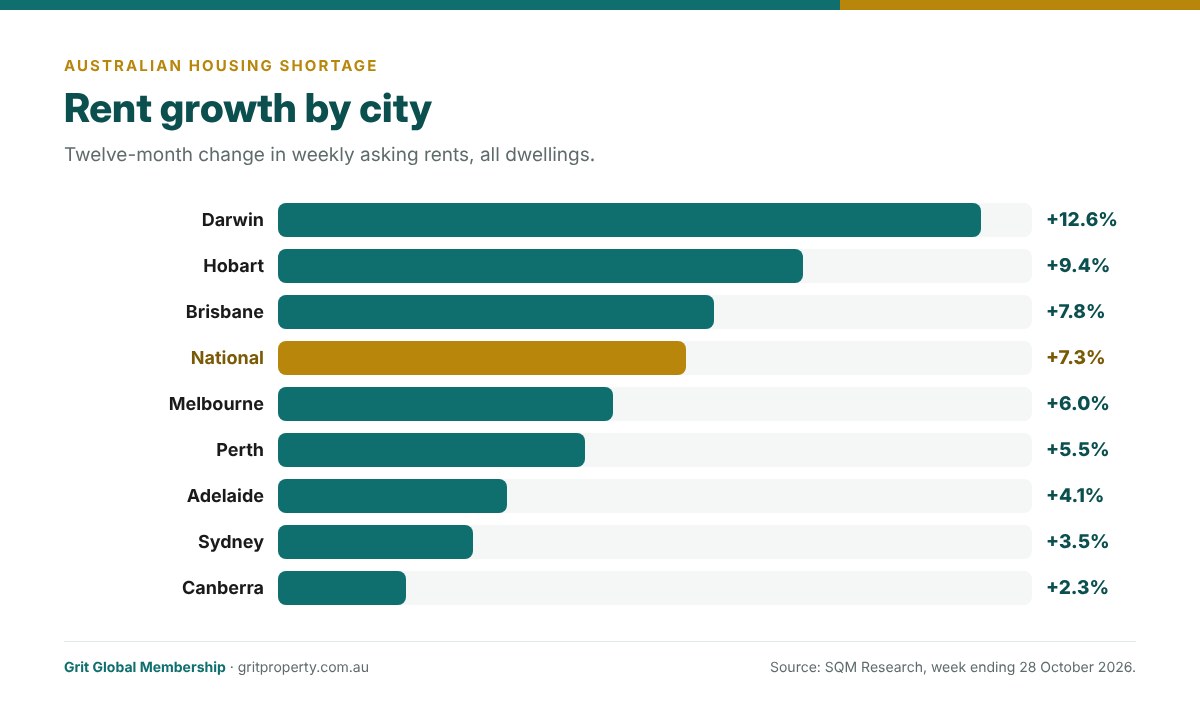
Twelve-month asking rent growth by city. Source: SQM Research, week ending 28 October 2026.
Watch: Property Development, What Investors Need to Know
Why supply is slow to respond
- Construction costs rose sharply, so some projects stopped stacking up.
- Builder insolvencies removed capacity.
- Skilled trades remain in short supply.
- Planning approvals take time, particularly for higher density housing.
What this does and doesn't mean for investors
A national shortage supports rents and, over time, values in well-located areas. It does not guarantee growth for every property. Prices have actually fallen nationally for six straight months to September 2026, according to Cotality, because rates and affordability matter too.
So the shortage is a tailwind, not a promise. Location, property type and local supply still decide individual results.
For younger buyers priced out of their preferred suburb, rentvesting in Australia is one way to enter the market. Whatever your approach, budget the full entry cost using Deposit for an Investment Property 2026.
Where the Australian housing shortage bites hardest
The national numbers hide big local differences. Rents rose fastest in Darwin, up 12.6% over 12 months, and Hobart, up 9.4%, according to SQM. Western Australia had the fastest population growth at 2.1%. In those places, the Australian housing shortage is felt most sharply by renters.
By contrast, rent growth was slowest in Canberra and Sydney. That doesn't mean there's no shortage there; it means affordability is limiting how far rents can rise.
What would close the gap
Closing the Australian housing shortage needs several things at once: lower construction costs, more builder capacity, faster approvals and more skilled trades. Completions rising 15.8% year on year is an encouraging start. Whether that pace can be sustained, and lifted towards the target, is the key question for the next two years.
For investors, the practical takeaway is to watch local supply as closely as national headlines. A shortage nationally can coexist with oversupply in a particular estate.
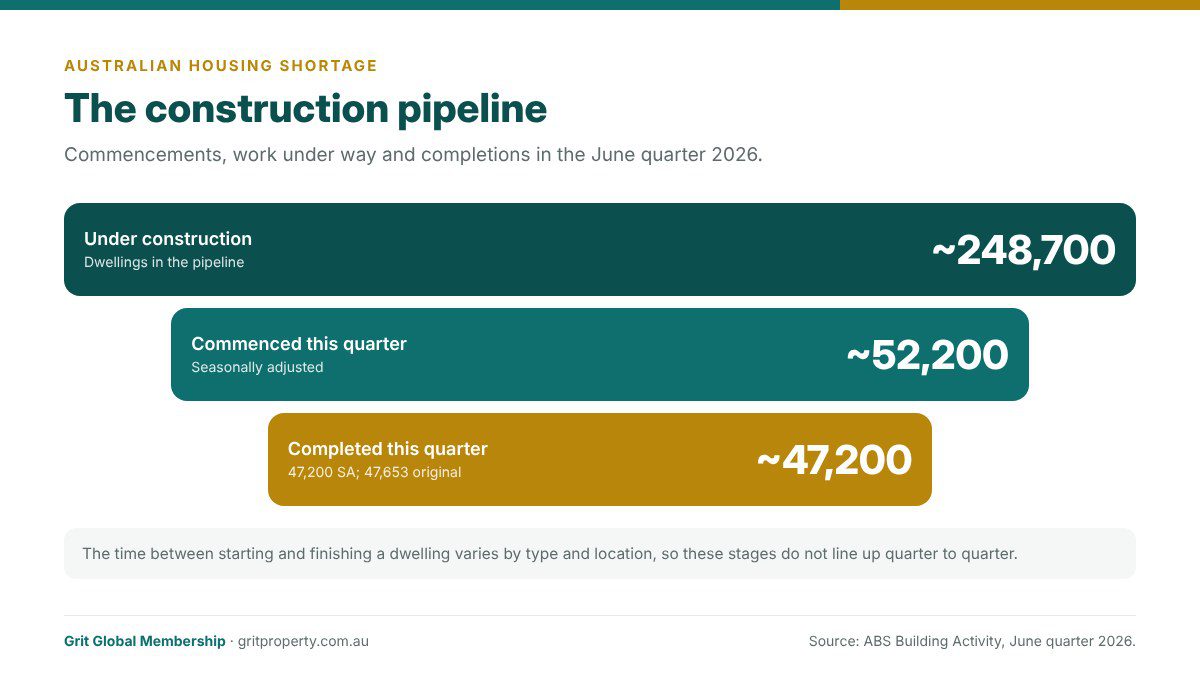
The construction pipeline, June quarter 2026. Source: ABS.
Key takeaways
- The Housing Accord target is about 240,000 homes a year.
- June quarter 2026 completions annualise to roughly 190,000.
- Population grew by 392,700 in the year to March 2026.
- National asking rents rose 7.3% over 12 months.
- The Australian housing shortage supports rents but doesn't guarantee price growth.
Frequently asked questions
How big is the Australian housing shortage?
At the June quarter 2026 pace, completions are running roughly 50,000 a year below the 240,000 Accord target pace. That is an approximate calculation, shown above.
Is building activity improving?
Yes. June quarter completions were up 15.8% on a year earlier, according to the ABS.
Why are rents rising?
Population growth has outpaced new supply, so competition for rentals remains strong.
Does the shortage mean prices will rise?
Not automatically. Interest rates, affordability and local supply also matter.
When is the next data update?
The next ABS Building Activity release is due 13 January 2027 and the next population release 17 December 2026.
Turning supply data into decisions
Grit checks supply, vacancy and population data down to suburb level before recommending any property. Grit Global Membership members get private investor deals, monthly masterclasses, global investor events and a one on one portfolio strategy review.
General information only. Figures are dated and sourced above and will change. This is general information, not financial advice.
Want to see how supply data looks in the suburbs you're considering? Book a strategy session.
👉 Join the Grit Global Membership and book your free strategy session here