
Industrial, medical, childcare, service stations and neighbourhood retail, side by side, with the eligibility rules first.
Quick answer: SMSF commercial property can still be bought with a limited recourse borrowing arrangement if it meets the definition of business real property. Commercial zoning alone does not make a property eligible. Industrial strata, medical suites, childcare centres, service stations and supermarket-anchored retail each carry different lease, vacancy and exit risks, so compare them on more than yield.
SMSF commercial property has become the main borrowing pathway for trustees since new residential borrowing stopped on 10 August 2026. That has created a rush of interest, and a rush is exactly when mistakes happen. The two most common ones: assuming any commercial building qualifies, and comparing assets on headline yield alone.
This guide starts with the rules, then compares five asset types honestly, including what can go wrong with each.
Rule one: eligibility comes before yield
The MFAA's summary of the new rules is clear: SMSFs can continue to use LRBAs for property that meets the definition of business real property, but a property being commercially zoned does not automatically make it eligible. Mixed-use properties need careful assessment.
Then there are the general SMSF rules that apply to any asset: the sole purpose test, related party restrictions, arm's length terms and the fund's investment strategy. Your SMSF specialist confirms all of these before anything else happens.
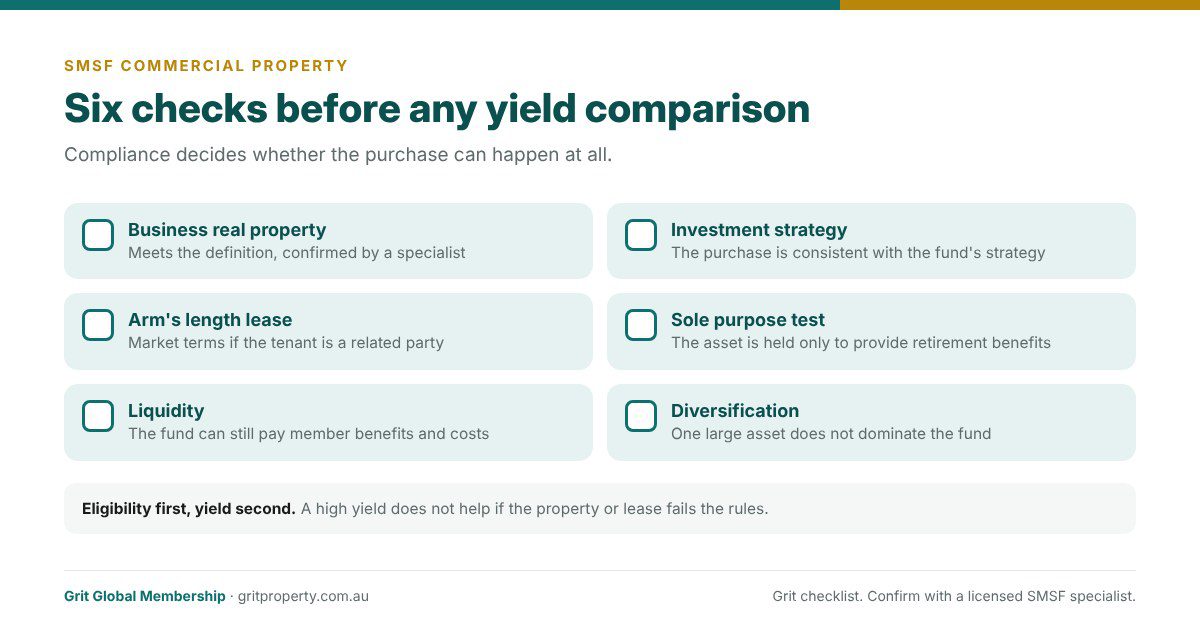
Eligibility and compliance checks come before any yield comparison.
Five asset types compared
SMSF commercial property: five asset types at a glance
Asset type
Indicative yield range*
Typical lease
Indicative entry
Main risks
Industrial strata
5.5% to 7% gross
3 to 5 years
$500k to $1.5m
Re-leasing time, specialised fit-out
Medical suites
5% to 6.5% net
Varies; sticky tenants
$600k to $2m
Related party rules; niche buyer pool
Childcare centres
5.5% to 7% net
10 to 15 years
$1.5m to $4m
Operator covenant; concentration
Service stations
4.5% to 5.5% net
15 to 20 years
$1.5m to $4m
Thin seller market; fund concentration
Supermarket-anchored retail
6% to 7.5% net
Mixed
$1m to $5m
Secondary tenant mix; management
Source: *Ranges from Grit analysis reported in Navin De Silva's Global Property Edge, Edition 11 (September 2026). Gross and net yields are not interchangeable. Indicative only; verify against a current market report before relying on them.
Industrial strata: the most accessible starting point
Small warehouses within larger complexes have been in strong demand thanks to e-commerce and last-mile logistics. Entry prices are lower than other commercial assets and the buyer pool is broad, which helps when the fund needs to exit.
The risks: when a tenant leaves, re-leasing can take months, and highly specialised fit-outs narrow your future tenant pool.
Watch: Why Warehouses Could Be the Next Big Move for Investors
Medical suites: tenants who rarely move
Practices invest heavily in fit-out and build patient relationships tied to a location, so they tend to stay. The catch for trustees in health professions: leasing to a related party is possible for business real property, but only on strict arm's length terms. Get advice before assuming.
Childcare centres: long leases, operator-dependent
Childcare leases are often long, with built-in rent reviews, and demand is supported by government subsidies to families. But the lease is only as strong as the operator. A national operator on a long lease is a very different risk from a small independent.
Service stations and neighbourhood retail
Service stations often come with long net leases to major operators, which suits trustees wanting low involvement, though entry prices are high and stock is limited. Supermarket-anchored strips can offer higher income, but the quality of the secondary tenants decides how reliable that income is.
Why tax makes commercial property attractive inside super
Inside an SMSF in accumulation phase, income is generally taxed at up to 15%, and assets held over 12 months receive a capital gains discount within the fund. Earnings supporting retirement phase pensions can be tax free, subject to conditions and caps.
Moneysmart's guide to SMSFs and property sets out the costs and risks clearly, including borrowing costs, which reduce net returns.
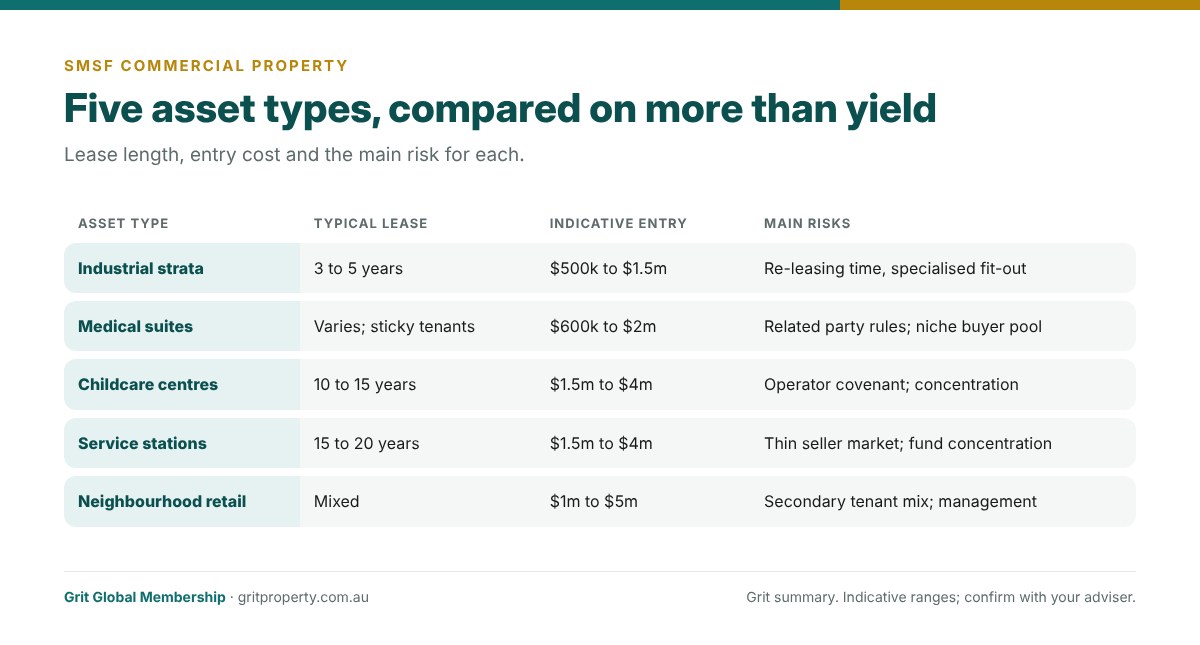
Comparing more than yield: lease, entry cost, vacancy and exit liquidity.
Sizing the investment to the fund
There's no magic fund balance that makes commercial property suitable. What matters is diversification, liquidity for member benefits, borrowing capacity and how much one property would dominate the fund. Your adviser will set limits that fit your fund.
Many investors keep building outside super at the same time using equity in their home, covered in How to Use Equity to Buy a Property. Commercial land also has different land tax implications, explained in Land Tax in Australia.
A worked example inside the fund
Take an illustrative SMSF that buys an $800,000 industrial strata unit with a $400,000 LRBA. At a 6% gross yield on a net lease, the unit earns about $48,000 a year before loan interest and fund costs. Inside accumulation phase, that income is taxed at up to 15%.
Now add the realistic parts: loan interest, fund administration and audit fees, insurance not covered by the tenant, and a possible vacancy of several months if the tenant leaves. SMSF commercial property can still work well, but the net figure is always lower than the headline yield.
Questions to ask before your SMSF buys
- Has a specialist confirmed the property meets the business real property definition?
- How would the fund pay member benefits if the property were vacant?
- What share of the fund would this one property represent?
- Who is the tenant, and how strong is their covenant?
- What does the lease say about outgoings, reviews and make good?
These questions protect the fund as much as any yield figure does.
Key takeaways
- SMSF commercial property can still be bought with an LRBA if it is business real property.
- Commercial zoning alone does not make a property eligible.
- Each asset type has different lease, vacancy and exit risks.
- Headline yields are not net returns.
- Have a licensed SMSF specialist confirm eligibility first.
Frequently asked questions
Can my SMSF still borrow to buy commercial property?
Yes, if the property meets the business real property definition. Commercial zoning alone is not enough.
Which SMSF commercial property is easiest to start with?
Industrial strata is often the most accessible because of lower entry prices and a broader buyer pool, but suitability depends on your fund.
Can I lease my SMSF's property to my own business?
For business real property, yes, on strict arm's length terms. Specialist advice is essential.
Are the yields in this article guaranteed?
No. They are indicative ranges from Grit's analysis and change with the market.
What's the biggest risk?
Concentration: one property dominating the fund, combined with vacancy and limited liquidity.
Property selection with the structure handled properly
Grit identifies and assesses the property; your licensed SMSF specialist handles eligibility and structure. Grit Global Membership members receive commercial and residential deal access, monthly masterclasses and a one on one portfolio strategy review.
General information only. This is general information, not a recommended asset allocation or financial advice. SMSF decisions require a licensed SMSF specialist.
If your SMSF is exploring commercial property, start with a strategy session.
👉 Join the Grit Global Membership and book your free strategy session here