

A neutral framework for one of the biggest money decisions you'll make, with the 2026 tax changes explained correctly.
Quick answer: There is no universal answer to 'should I sell my investment property'. Compare three options on the same numbers: sell, hold, or refinance to release equity. Look at after-tax net proceeds, cash flow, capital gains tax timing, the property's fundamentals and what you would do with the money. Selling can be the right call; so can holding.
Should I sell my investment property? It's a question more owners are asking as prices have softened. Cotality reported national home values fell for a sixth straight month in September 2026, and a falling market makes people nervous. Nervous is a bad state for a big decision.
So rather than tell you what to do, this guide gives you a calm way to decide. We'll compare the three real options, explain the 2026 tax changes correctly, and list the situations where selling is the rational choice.
The market backdrop, briefly
According to Cotality's September 2026 update, national values were 5.2% below the March 2026 record, with sales volumes down and listings up. Darwin was the only capital to rise in September.
Falling prices are a reason to think carefully, not a reason in themselves to sell. Plenty of sound properties dip in value and recover. Plenty of weak ones don't.
Your three options side by side
Sell, hold or refinance: what each option changes
Sell
Hold
Refinance / release equity
Cash now
Net proceeds after costs and tax
None
Equity released as a loan
Ongoing cash flow
Rent and costs stop
Continues as now
Higher repayments
Capital gains tax
Triggered on sale
Deferred
Deferred
Exposure to future growth or falls
Ends
Continues
Continues, with more debt
Main risk
Selling below value; reinvestment risk
Holding a weak asset too long
More debt if rates or rents move against you
Source: Grit decision framework. General information only.
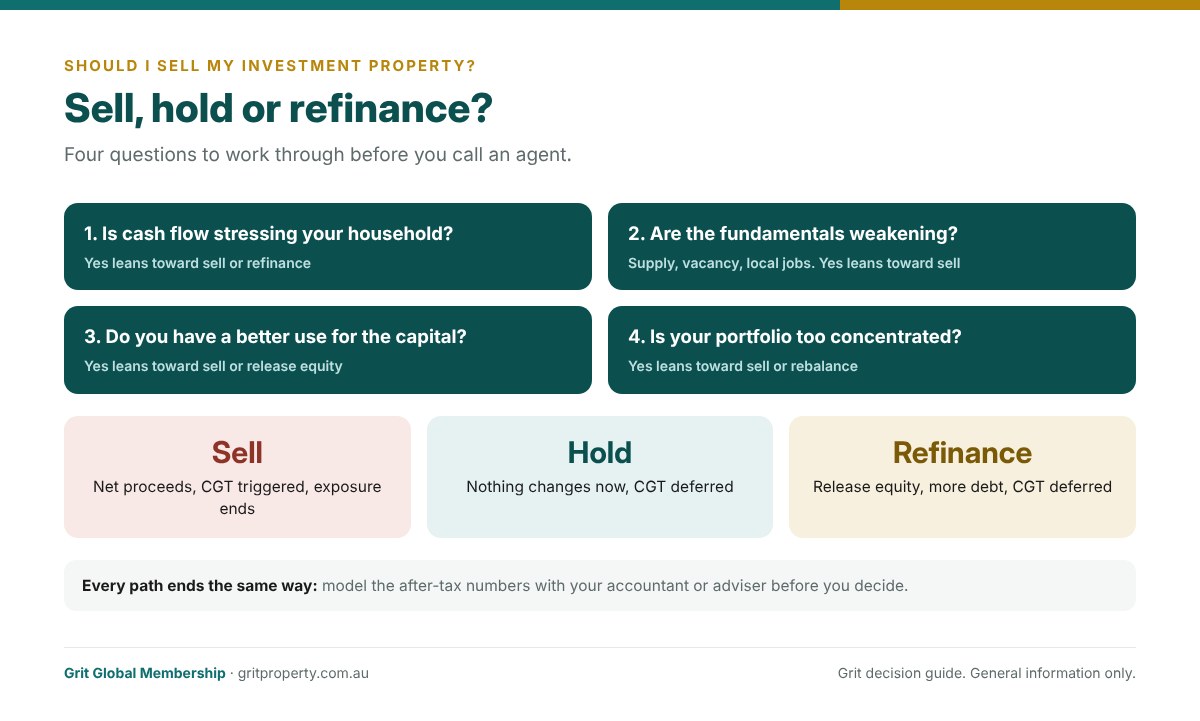
A simple decision path. Confirm the numbers with your adviser.
The 2026 tax changes, explained correctly
Two reforms matter here, and they work differently.
- Negative gearing: properties held at 7:30pm AEST on 12 May 2026 are exempt. If you sell and buy another established property, the new one falls under the new rules from 1 July 2027.
- Capital gains tax: the 50% discount is replaced with indexation and a 30% minimum tax for gains that accrue after 1 July 2027. This applies based on when a gain accrues, not just when you bought.
Both measures are summarised on the ATO's tax reform page. Because the CGT change depends on timing, the year you sell can affect your tax. That is a conversation for your tax adviser, with your actual figures.
When selling can be the right decision
- Holding costs are genuinely straining your household budget.
- The property's fundamentals have weakened: rising local supply, a major employer leaving, persistent vacancy.
- Your portfolio is concentrated in one suburb, city or property type.
- You have a clearly better use for the capital, and the after-tax numbers prove it.
- Life has changed: retirement, separation, downsizing or a move.
None of these is a failure. If you sell your investment property at the right time for the right reason, that is good portfolio management.
Watch: How She Sold Her Home and Found the Perfect Downsized Property
When holding usually makes more sense
In these situations, the urge to sell your investment property is often a reaction to headlines rather than to the asset itself.
- The asset is sound and the fall is market-wide rather than property-specific.
- You can comfortably fund it, with a buffer.
- Selling costs and tax would absorb much of the gain.
- The property is exempt from the negative gearing change and you would lose that by switching to an established purchase.
Refinancing: useful, but not free
Releasing equity lets you access capital without selling, as explained in How to Use Equity to Buy a Property. But it increases your debt. If rates rise or rents fall, a refinanced portfolio feels it harder. Treat it as a tool, not a default.
A simple net-proceeds worksheet
Work out what you would actually walk away with
Line
Your figure
Expected sale price
$
Less: agent commission and marketing
$
Less: legal and conveyancing
$
Less: loan discharge (balance owing)
$
Less: estimated capital gains tax (from your adviser)
$
Equals: net cash in hand
$
What would this money do next, and at what return?
Source: Grit worksheet. Fill in with figures from your agent, lender and tax adviser.
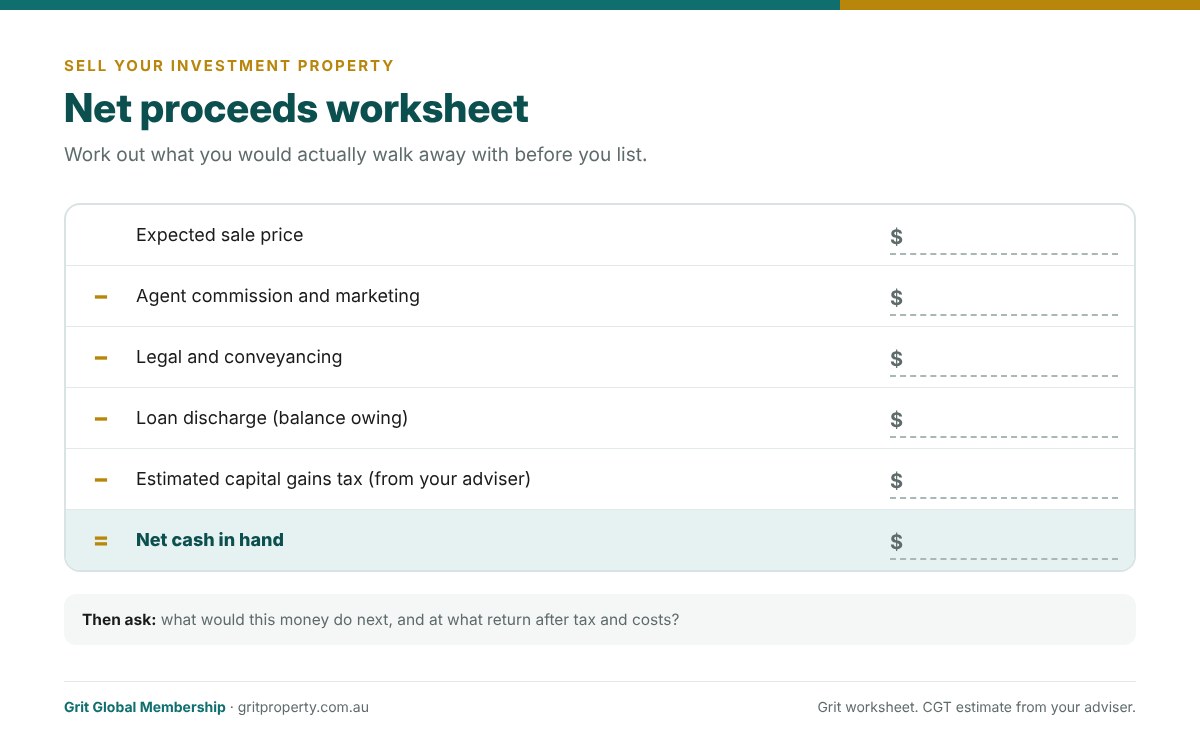
Use this worksheet before listing.
For background on the rules your exempt property keeps, see Negative Gearing in Australia 2026.
Three owners, three different answers
Here are three illustrative owners asking whether to sell your investment property, and how the framework leads each to a different answer.
- Lena owns a sound unit in a suburb with low vacancy, but values dipped. Her cash flow is fine. She holds, because the fall is market-wide and her property is solid.
- Marcus owns a house in a town where the main employer has announced closure, and vacancy is rising. For him, the fundamentals have weakened, so it makes sense to sell your investment property and redeploy the capital, which is what he does.
- Priya needs cash for a business but loves her property's prospects. She refinances to release some equity, with a buffer for higher rates.
Same question, three sensible answers. That's why a framework beats a rule of thumb.
Before you sell your investment property: five checks
- Ask an agent for a realistic sale price, not the highest quote.
- Get a written capital gains tax estimate before you list.
- Work out exactly where the money would go, and what it would earn.
- Compare with refinancing, including higher repayments.
- Decide whether you'd regret selling your investment property if the market turned up next year.
If you still want to sell your investment property after these checks, you'll be doing it with clear eyes. And if you decide not to sell your investment property, you'll know why.
Key takeaways
- There is no universal answer to whether to sell.
- Compare selling, holding and refinancing on after-tax numbers.
- Negative gearing exemption and CGT timing work differently.
- Selling can be rational when fundamentals weaken or cash flow strains.
- Refinancing keeps the asset but adds debt.
Frequently asked questions
Should I sell my investment property because prices are falling?
Not on that basis alone. Check whether the fall is market-wide or specific to your property, and compare all three options on after-tax numbers.
Will I lose my negative gearing exemption if I sell?
The exemption attaches to properties held at Budget night. An established replacement bought later falls under the new rules from 1 July 2027.
Does the CGT change affect me if I bought years ago?
It applies to gains accruing after 1 July 2027, so long-term owners can be affected. Ask your adviser how your gain will be split.
Is refinancing safer than selling?
Not necessarily. It keeps the asset but adds debt and risk.
Who should I speak to?
A registered tax agent for tax, your lender for refinancing, and an agent for a realistic sale price.
A second opinion before you list
Grit Global Membership includes a one on one portfolio strategy review that compares selling, holding and refinancing with real numbers, alongside monthly masterclasses and private investor deals across three countries. If selling is the right answer, we'll say so.
General information only. This is a general decision framework, not tax, legal or financial advice. Tax outcomes depend on your circumstances; speak with a registered tax agent.
Not sure whether to sell, hold or refinance? Talk it through in a free strategy session.
👉 Join the Grit Global Membership and book your free strategy session here