

From land contract to first rent cheque, here's everything that costs money and everything that can go wrong.
Quick answer: House and land packages pair a block of land with a separate contract to build a new home. For investors, they keep negative gearing against other income from 1 July 2027 and usually carry strong depreciation. The main risks are builder quality, construction delays, variations and overpaying, so the full project cost and the builder deserve as much scrutiny as the suburb.
House and land packages have moved from a first home buyer product to a mainstream investor strategy in 2026. The reason is policy: new builds keep tax benefits that newly bought established homes lose. But the brochure price is rarely what you end up paying, and the riskiest part of the deal is often the part you can't see yet.
Picture an illustrative investor, Ravi, signing on a $650,000 package in Melbourne's west. Twelve months later he's paid interest on land with no tenant, approved two variations, and found a defect at handover. None of that was in the advertised price. This guide is about avoiding Ravi's year.
How house and land packages work
Most packages involve two contracts: one for the land and one for the build. The land usually settles first. The build is then paid in stages, such as slab, frame, lock up and completion, as construction progresses.
That two-contract structure affects your stamp duty, your loan and your cash flow during construction. It also means two sets of terms to read carefully.
Stamp duty depends on your state and your contract
You will often hear that duty is only paid on the land. That can be true in some situations, but it is not a safe general rule. Treatment depends on the state, how the contracts are structured and your circumstances.
The full project cost checklist
What a house and land package can really cost
Cost item
When it hits
Notes
Land price
Land settlement
Check comparable land sales in the estate
Construction contract
Staged payments
Fixed price with exclusions listed
Site costs (soil, slope, rock)
Before or during build
Often excluded from 'from' prices
Connections and services
During build
Water, power, NBN, sewer
Stamp duty
Land settlement (varies by state)
Check your state revenue office
Legal and conveyancing
Both contracts
Get the build contract reviewed independently
Loan interest during construction
From land settlement
No rent until completion
Independent stage inspections
Slab, frame, lock up, handover
A few hundred dollars each
Insurance
From settlement
Check builder's warranty insurance too
Variations and upgrades
During build
The most common budget blowout
Landscaping, fencing, window coverings
Before tenanting
Often not included
Vacancy before first tenant
After handover
Have your property manager ready
Source: Grit due-diligence checklist. Costs vary by state, builder and site.
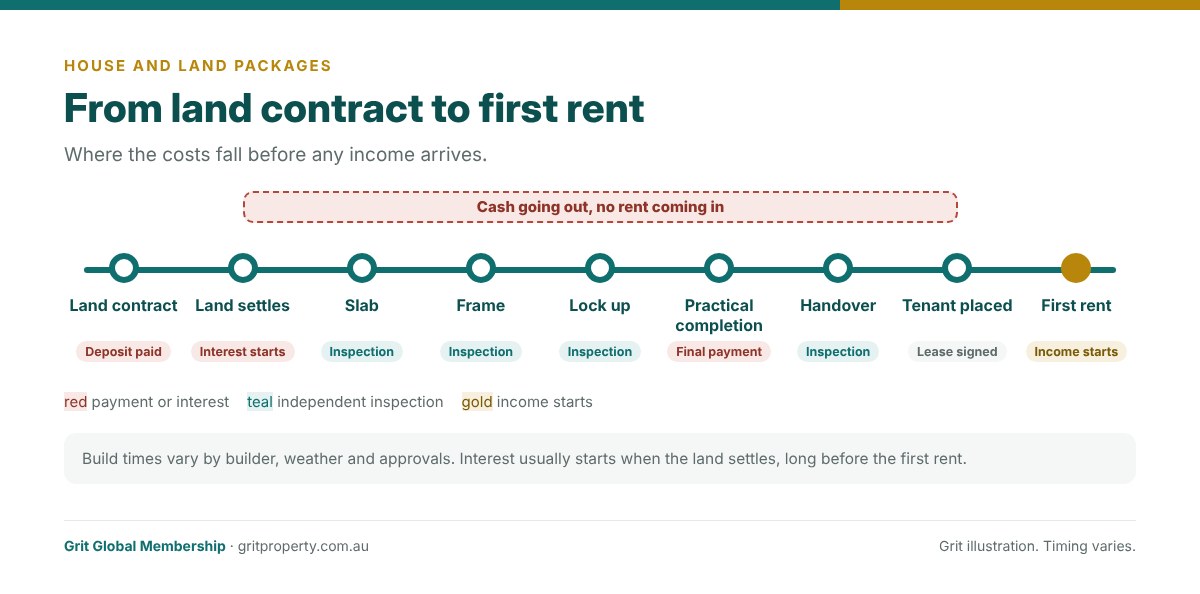
From land contract to first rent: where costs fall before any income arrives.
Builder risks to check before signing
- Licensing, history of disputes and recent completed homes you can inspect.
- Financial stability; builder insolvencies have been a real risk in recent years.
- Fixed price contract with site costs and exclusions clearly listed.
- How variations are priced and approved.
- Sunset clauses and what happens if the project runs late.
- Warranty and home warranty insurance cover.
- Rental guarantees, which can hide an inflated price.
If any answer is vague, treat that as information. A good builder answers these questions easily.
Watch: Property Development, What Investors Need to Know
The tax side
From 1 July 2027, negative gearing is limited to new builds, and new build investors can choose the 50% CGT discount or the new indexation arrangements, according to the Budget 2026-27 tax reform summary. Depreciation on a new home is also usually higher than on an older one.
Those are real advantages. But a tax benefit cannot fix overpaying or weak demand. Judge the package on its price, its builder and its estate first.
Choosing the right estate
In Melbourne's outer north and west, Grit's analysis in August 2026 found packages in suburbs such as Craigieburn, Truganina, Wollert and Fraser Rise priced from about $620,000 to $720,000. Prices and selling times change, so check current figures before relying on them.
- How many lots are still to be released in the same estate?
- Is local rental vacancy low and stable?
- Is the infrastructure funded and underway, or only proposed?
- Do comparable new homes nearby support the package price?
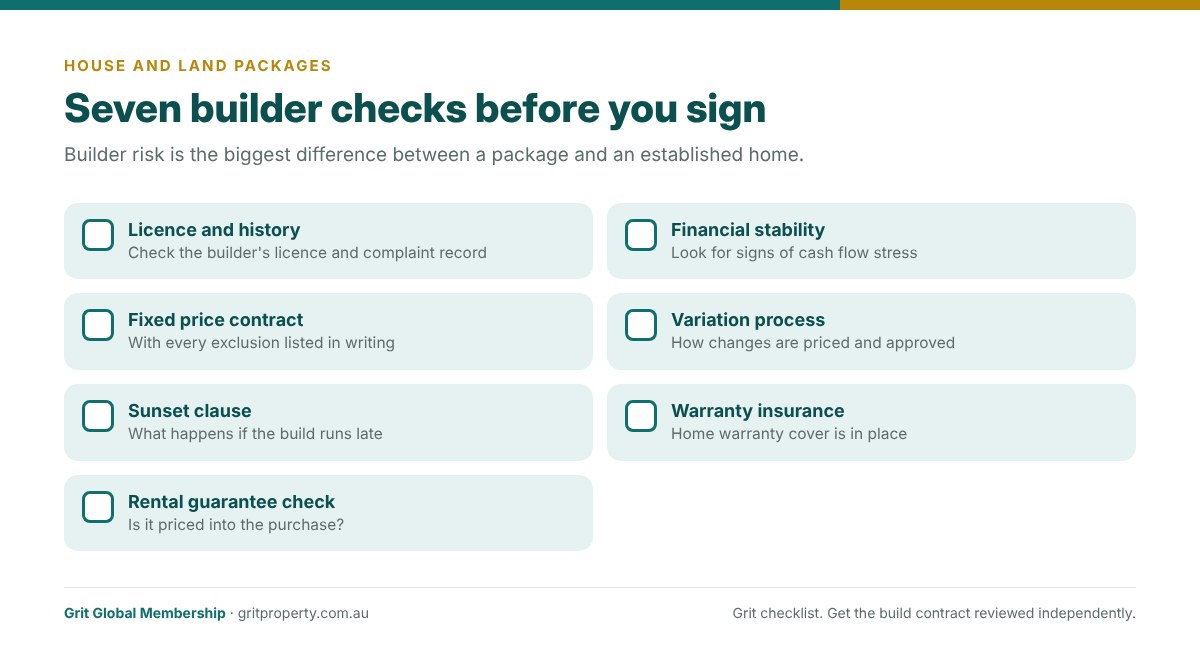
Seven builder checks before you sign.
Budget for the deposit, duty, fees and a buffer that covers construction, as explained in Deposit for an Investment Property 2026. For the tax background, read Negative Gearing in Australia 2026.
Ravi's year, revisited
Remember Ravi from the start of this article? Here's how the checklist would have changed his year. A fixed price contract with site costs listed would have prevented one variation. An independent slab inspection would have caught the defect early. And having his property manager lined up before handover would have cut his empty weeks.
House and land packages reward the investor who treats the build as a project to manage, not a product to buy.
Rental guarantees: read the fine print
Some house and land packages come with a rental guarantee for the first year or two. That can be genuinely useful, but it can also mask a price set above the market. Before relying on one, compare the guaranteed rent with current asking rents for similar new homes nearby, and ask who pays the guarantee if the developer runs into trouble.
If the guaranteed rent is well above the local market, ask why. The answer is often in the purchase price.
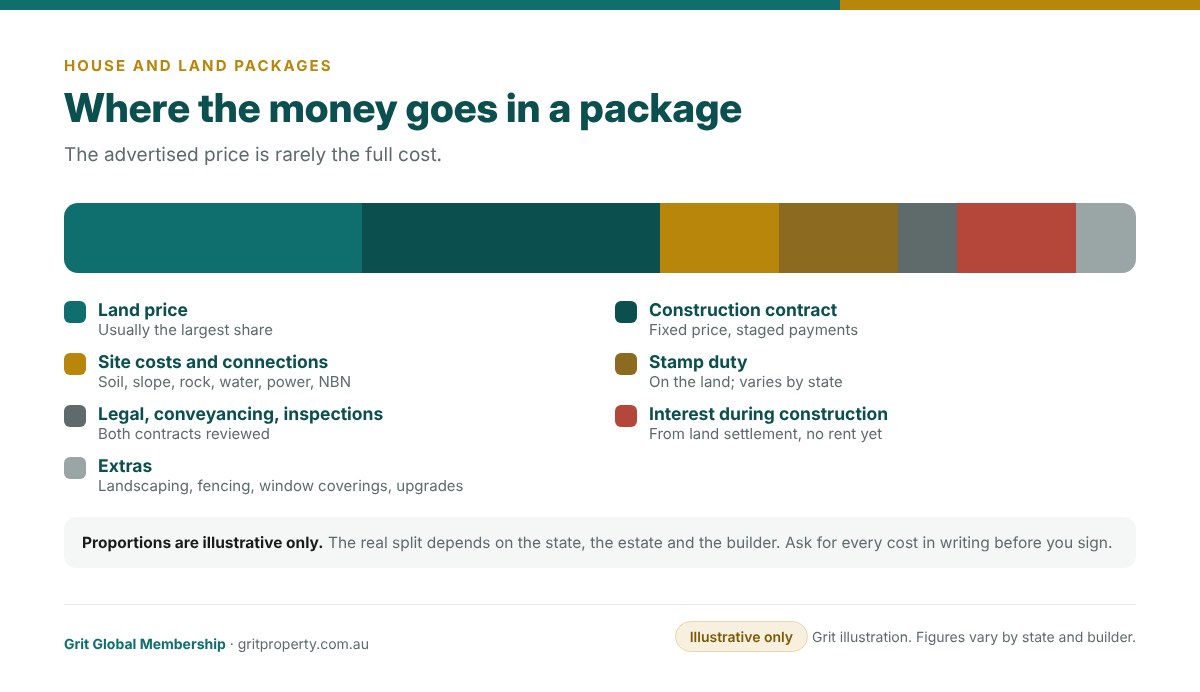
Where the money goes in a typical package. Illustrative only.
Key takeaways
- House and land packages keep negative gearing against other income from 2027.
- The advertised price rarely includes every cost.
- Stamp duty treatment depends on your state and contract.
- Builder quality is the biggest single risk.
- Plan for interest with no rent during construction.
Frequently asked questions
Are house and land packages a good investment?
They can be, if the price, builder and estate are right. Tax benefits help but cannot rescue a poor purchase.
Do house and land packages keep negative gearing?
As new builds, they keep negative gearing against other income from 1 July 2027, according to the Budget summary.
Is stamp duty only paid on the land?
Not always. It depends on your state and contract structure, so check with your state revenue office or conveyancer.
How long does a build take?
Often around a year or more, depending on the builder and site. Budget for interest with no rent during that time.
What is the biggest risk?
Choosing the wrong builder or overpaying for the package.
Where Grit fits in
Grit assesses builders and corridors directly and matches builder, site and budget for each client. Grit Global Membership members get private investor deals, monthly masterclasses and a one on one portfolio strategy review that tests the full project cost, not just the advertised price.
General information only. Stamp duty and tax treatment vary by state and personal circumstances. This is not legal, tax or financial advice.
Comparing packages or builders? Bring them to a strategy session and we'll go through the numbers together.
👉 Join the Grit Global Membership and book your free strategy session here