

Same price, same rent, same loan. The only differences are the ones the tax rules and the asset itself create.
Quick answer: On the same price, rent and loan, a new build property can cost noticeably less to hold after tax from 2027, because new builds keep negative gearing against other income and usually carry larger depreciation. Established homes often hold more land and sit in proven locations. Neither wins automatically; the right choice depends on the specific asset.
New build property and established homes used to be compared mostly on taste and location. After the 2026 Budget, the tax rules pull them apart. But here's the trap: many comparisons online stack the deck by using different prices, rents or loans. That tells you nothing about the tax effect itself.
So we did the opposite. We used one set of numbers and ran it through both. Then we looked at what the tax line cannot tell you.
The rule that created the gap
From 1 July 2027, negative gearing is limited to new builds, according to the Budget 2026-27 tax reform summary. Investors who buy new builds can still deduct losses from other income. Investors who buy established housing after Budget night can only deduct losses against residential property income, carrying unused losses forward.
On capital gains, new build investors can choose the 50% discount or the new indexation rules. Established property gains that accrue after 1 July 2027 fall under the new rules.
A like-for-like comparison
Both properties below cost $650,000, rent for $500 a week, and are bought with an 80% interest-only loan. The only differences are depreciation and how the tax loss can be used.
Illustrative annual comparison (from the 2027-28 income year)
New build property
Established home (bought after Budget night)
Purchase price
$650,000
$650,000
Rent ($500/week)
$26,000
$26,000
Interest (80% loan, 6.5% assumed)
$33,800
$33,800
Other costs (rates, insurance, management, repairs)
$6,000
$6,000
Cash loss before tax
$13,800
$13,800
Depreciation (assumed)
$10,000
$2,000
Tax loss
$23,800
$15,800
Can it reduce salary tax?
Yes
No (carried forward)
Tax refund at 37% marginal rate
About $8,800
$0 this year
After-tax cost this year
About $5,000 ($96/week)
$13,800 ($265/week)
Source: Grit illustration only. Assumptions: 6.5% interest, $6,000 other costs, depreciation figures assumed (a quantity surveyor sets actual amounts), 37% rate excluding Medicare levy, no other residential property income. Excludes growth, rent changes and selling costs.
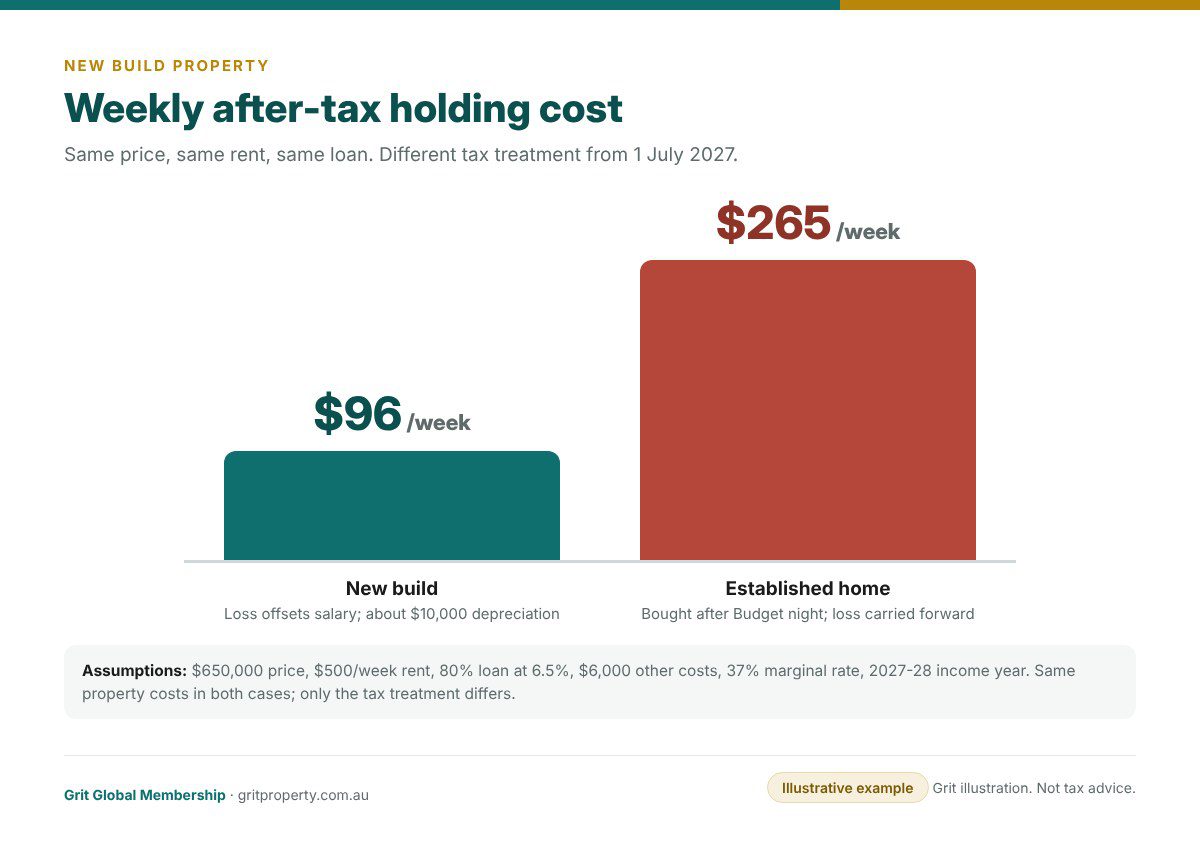
Weekly after-tax holding cost in the illustrative example.
In this example, the new build costs roughly $170 a week less to hold. Over five years, that is a meaningful amount of cash. But it is only half the story.
What the tax line can't tell you
Cheaper to hold is not the same as better to own. Over ten or twenty years, growth usually matters more than holding costs. And growth is driven largely by land and location.
- Land component: established houses often sit on more land, and land is what tends to appreciate.
- Location: established homes are more often in mature, proven suburbs.
- Construction risk: new builds can face delays, defects and builder insolvency.
- Supply: a new estate releasing hundreds of similar homes can hold back early growth.
So an established home in a strong location can still be the better investment, even with the higher holding cost. The point is to compare the full picture.
Watch: How Much Tax Are You Secretly Losing on Your Rental Income?
How to check a 'new build' is really new
Marketing labels are not tax definitions. Before you rely on any benefit:
- Ask whether the dwelling has ever been sold or lived in.
- Get the construction completion date in writing.
- Be cautious with heavy renovations sold as 'new'.
- Get written confirmation from a tax adviser, and a depreciation estimate from a quantity surveyor.
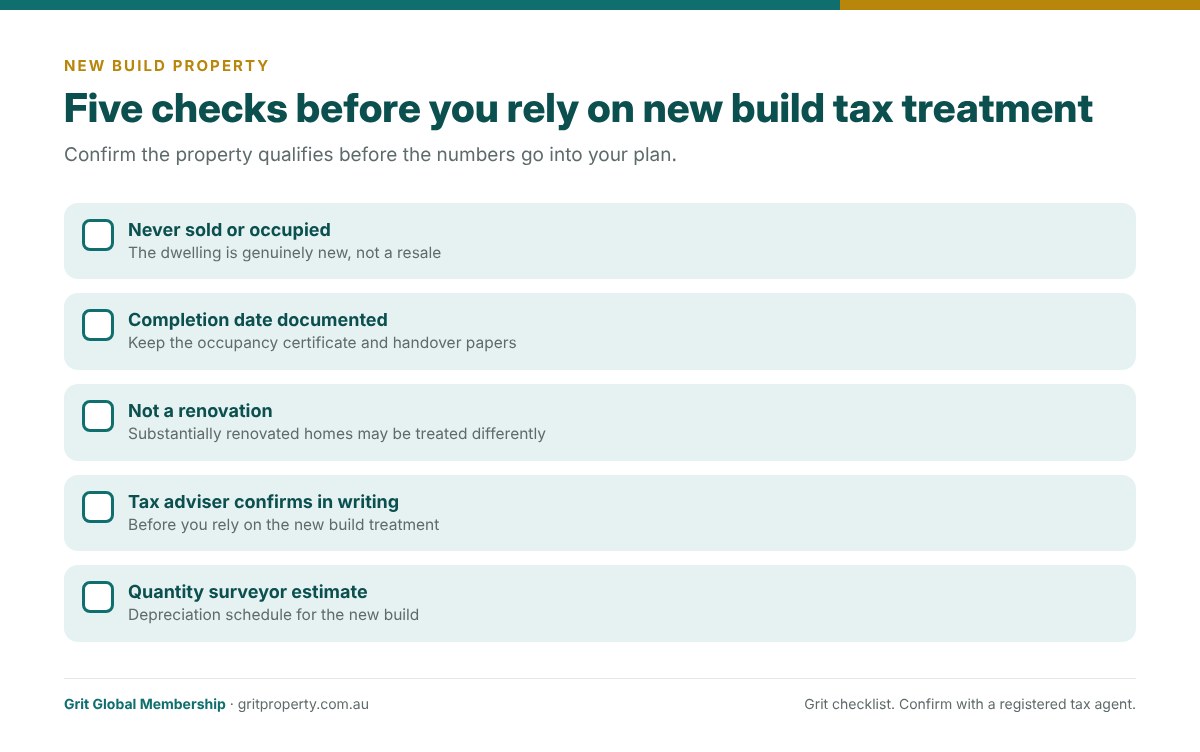
Five checks before relying on new build tax treatment.
Which suits which investor?
A simple guide by investor profile
Investor profile
Often leans towards
Why
Higher income, buying now, needs lower holding cost
New build
Losses can offset salary; larger depreciation
Already owns exempt established property
Hold and review on merits
Existing treatment unchanged
Long horizon, focused on land growth
Either, judged on location
Land and location drive long term results
Low tolerance for construction risk
Established
No build delays or builder risk
Source: Grit general guidance, not personal advice.
Whichever way you lean, budget for the full entry cost, as explained in Deposit for an Investment Property 2026. For how negative gearing works in general, see Negative Gearing in Australia 2026.
Where new build property can disappoint
It's worth being honest about how new build property goes wrong, because the tax benefits can make buyers less careful.
- Paying a premium: some packages are priced well above comparable homes, wiping out years of tax savings.
- Estate oversupply: when hundreds of similar homes finish at once, rents and resale values can stall.
- Builder trouble: delays, defects and insolvency can turn a good plan into a long headache.
- Smaller land: many new homes sit on compact lots, which can limit long-term growth.
None of these are reasons to avoid new builds. They're reasons to check the price, the builder and the estate as carefully as you check the tax.
Where established homes still shine
Established homes in mature suburbs often come with larger blocks, proven rental demand and transport, schools and shops already in place. You can see exactly what you're buying, inspect the neighbours and check years of sales history.
For an investor who prioritises land and location over holding cost, that can outweigh the tax difference, particularly over a long horizon.
Key takeaways
- A new build property can cost less to hold after tax from 2027.
- Established homes often offer more land and proven locations.
- Compare both on the same price, rent and loan.
- Verify 'new build' status in writing before relying on it.
- Location and price usually matter more than the tax line.
Frequently asked questions
Is a new build property better than an established home after the Budget?
It can be cheaper to hold after tax, but long term results depend more on land, location and price. Compare both on the same assumptions.
Do new builds keep negative gearing?
Yes. The Budget summary says investors who buy new builds can still deduct losses from other income.
What about capital gains tax on a new build?
New build investors can choose the 50% discount or the new indexation arrangements.
How much depreciation can I claim?
It depends on construction costs and fittings. A quantity surveyor's schedule sets the actual figures.
Can I still buy established property?
Yes. Make sure the numbers work without a wage offset from 1 July 2027.
Comparing real properties, not brochures
The hard part is not the maths; it's knowing whether a specific builder, estate or suburb deserves your money. Grit assesses builders and growth corridors directly, and members of Grit Global Membership get private investor deals, monthly masterclasses and a one on one portfolio strategy review that runs comparisons like this on real properties.
General information only. The figures above are illustrative and not a forecast or tax advice. Confirm tax treatment with a registered tax agent and depreciation with a quantity surveyor.
Weighing a new build against an established home? Bring both to a strategy session and we'll compare them properly.
👉 Join the Grit Global Membership and book your free strategy session here