
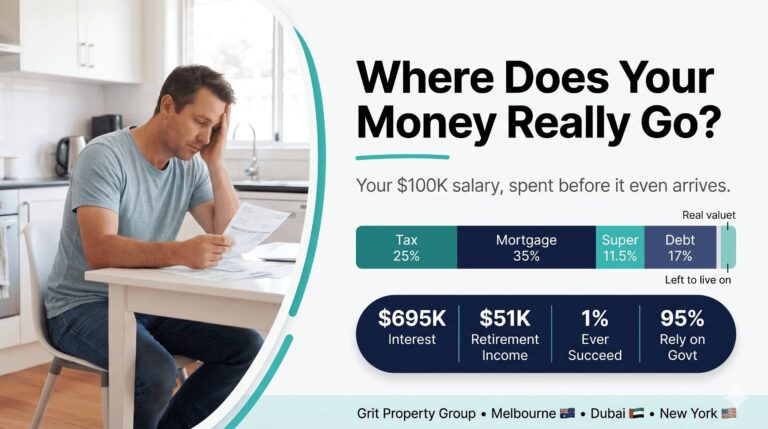
Why hardworking Australians end up with nothing, and what the top 1% quietly do differently
Let me ask you something, honestly.
You work hard. You show up every day. You pay your taxes without complaint, you make your mortgage repayment every single month, and you try to be sensible with money. So why is it that at the end of the year, you look at your bank account and think, where did it all go?
If that sounds familiar, you’re not broken, and you’re not bad with money. You’re just caught in a system that very few people ever explain properly. So let’s pull back the curtain and look at exactly what happens to your money, because once you see it, you can’t unsee it.
Picture your pay for a week
Imagine you earn $100,000 a year. You go to work on Monday thinking, great, I’m earning money today. But here’s what actually happens to that money before it ever reaches your pocket.
First, around 25% disappears into taxes. There goes Monday, gone before you’ve even had your morning coffee.
Next, roughly 35% goes to your mortgage or rent. That’s Tuesday and half of Wednesday, vanished.
Then 11.5% goes into your superannuation. There goes the rest of Wednesday and into Thursday.
After that, about 17% goes to car loans, credit cards, and personal debts, the things most of us are quietly carrying. That’s Thursday and half of Friday gone.
And whatever’s left over? That’s what you actually live on. Groceries, school fees, the kids, a little bit of fun. Your whole week of work is spoken for before you’ve even decided what to do with it.
The part nobody warns you about
Here’s where it gets really painful.
Say you have a $600,000 mortgage at 6% over 30 years. Over the life of that loan, you’ll pay more than $695,000 in interest alone. Read that again. The interest costs more than the house itself. You’re not just buying your home, you’re effectively buying the bank a second house, and handing it over for free.
And over a lifetime, the average Australian will hand more than $1 million in taxes to the government.
So what’s waiting at the finish line after all that effort? The average retirement income in Australia is just $51,000 a year. Most people retire with under $200,000 in super. And around 95% of Australians end up relying on some form of government support.
The safety net you’re counting on is fraying
Here’s the uncomfortable truth almost nobody talks about. That government support is under serious pressure.
Both Bloomberg and Ernst & Young have flagged Australia’s long-term spending as unsustainable. With an ageing population, rising healthcare costs, and ongoing deficits, the pension system your parents leaned on simply may not be there in the same form when it’s your turn.
And here’s the most sobering statistic of all. Data drawn from around 2 million property investors in Australia shows that only 1% ever succeed in building a real, lasting portfolio. One percent.
So what does that 1% understand?
They’ve figured out two things the other 99% haven’t.
First, you can’t simply out-earn this problem. Working harder and earning more just means more tax and more lifestyle creep. The treadmill speeds up, but you don’t get anywhere.
Second, you can’t safely rely on a pension that may not be there.
So what’s left? The answer is a global property portfolio. A strategy that puts your money to work across multiple countries, generating income while you sleep, instead of leaving it all riding on one salary and one shaky safety net.
That’s exactly what we unpack in our free 30-minute Grit Global Membership webinar. No jargon, no hard sell, just a clear and honest look at how ordinary Australians are quietly building extraordinary portfolios.
👉 Watch the free 30-minute webinar here
It costs you nothing but 30 minutes, and it might just change the way you think about money for the rest of your life.