
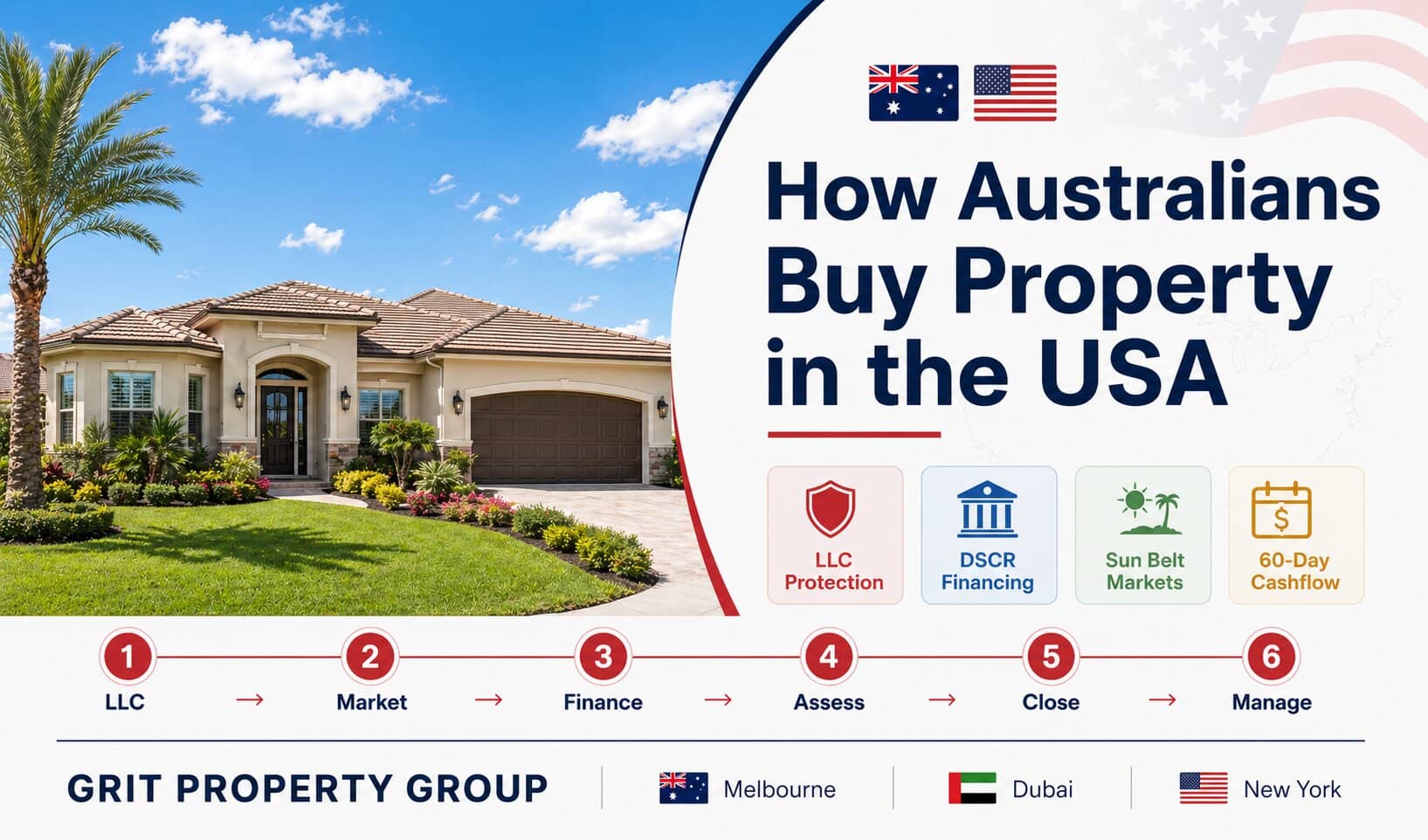
How Australians Buy Property in the USA — Step by Step
The complete process from structure setup to cashflow in 60 days — for Australian investors entering the US market.
GRIT Property Group
Melbourne · Dubai · New York
The United States is the world's most liquid, most transparent, and most data-rich property market. It is also one of the most accessible for foreign investors — if you know the process.
Vacancy rates, rental comps, days on market, transaction history, neighbourhood income data — all of it is publicly accessible. For a data-driven investor, this transparency is an enormous advantage.
What makes the US different for Australians is not the property itself. It is the legal structure, the financing approach, and the property management setup that determine whether your investment performs or underperforms.
Establish your LLC before you do anything else
The first step is not finding a property. It is setting up a Limited Liability Company (LLC) — the legal structure through which Australian investors should own US property.
| Reason | Detail |
|---|---|
| US estate tax protection | Non-residents face US estate tax on assets above ~USD $60,000. An LLC removes property from your personal estate |
| Personal liability | An LLC limits liability to the assets of the LLC — not your personal assets in Australia |
| Tax efficiency | Single-member LLC = disregarded entity for US tax. Income flows to your return with full access to deductions |
| Professional credibility | US banks, property managers, and sellers transact with LLCs routinely. Operating without one signals inexperience |
How to set up a US LLC from Australia
Choose a state of formation
Delaware and Wyoming most common — low fees, strong privacy, flexible operating rules
Engage a US formation service or attorney — USD $500–$1,500
File Articles of Organisation; obtain EIN (Employer Identification Number) from the IRS
Open a US bank account in the LLC name
Required to receive rental income, pay expenses, and hold purchase funds
Obtain an ITIN — USD $300–$500
Individual Taxpayer Identification Number — required for filing US tax returns as a foreign national
The entire process can be completed from Australia in 2–4 weeks. Annual maintenance: USD $300–$800/year (state filing + registered agent).
Identify your target market
"The US property market" is not one market — it is hundreds of local markets. GRIT focuses on Sun Belt rental markets — cities sharing strong fundamentals: population growth, job creation, landlord-friendly regulation, and strong rental demand.
| Market | Why GRIT watches it |
|---|---|
| Greater Dallas–Fort Worth, TX | No state income tax; fastest-growing major metro; diversified tech, finance, logistics |
| Nashville, TN | No state income tax; strong population inflow; major healthcare and tech hub |
| Jacksonville, FL | No state income tax; strong port economy; competitive entry prices |
| Raleigh–Durham, NC | Research Triangle — tech, pharma, universities; consistent growth; strong demand |
| Charlotte, NC | Major banking hub; population growth from NE cities; strong infrastructure |
| Greater Phoenix, AZ | Sun Belt growth leader; large rental pool; strong short and long-term demand |
What GRIT looks for: Population growth above 1.5% p.a., vacancy below 5%, net yield above 5%, landlord-friendly regulation, diversified employment, no state income tax (where possible).
Understand your financing options
Australian investors cannot use an Australian mortgage for US property. The primary vehicle is a DSCR loan — assessed on the rental income of the property, not your personal income.
| Type | What it is | For Australians? |
|---|---|---|
| DSCR loan | Assessed on rental income, not personal income | Yes — recommended |
| Conventional US mortgage | Requires US credit history and income docs | Very limited |
| Cash purchase | Full purchase from equity or savings | Yes — fastest path |
| Portfolio lender | Private lenders with flexible criteria; typically higher rates | Available in some markets |
Typical DSCR Loan Parameters (Foreign National)
65–75%
LVR (25–35% deposit)
1.0–1.25x
DSCR coverage ratio
30 yr
Fixed or adjustable
LLC
Required by most lenders
Find and assess the property
US property searches use the MLS (Multiple Listing Service) — a publicly accessible database with full transaction history, comparable sales, and rental data. Unlike Australia, there is no information asymmetry.
| Factor | Target |
|---|---|
| Gross rental yield | 7%+ |
| Net yield (after all costs) | 5%+ |
| Property age | Post-2000 preferred — lower maintenance, higher depreciation |
| Type | Single-family homes or small multifamily (2–4 units) |
| School district | A or B rated — drives tenant quality and reduces vacancy |
| Flood zone | Avoid FEMA Flood Zone AE — mandatory flood insurance is costly |
Settlement (closing)
US settlement is called closing and is managed by a title company — an independent third party that holds funds in escrow, verifies documents, and disburses funds. Australians can close 100% remotely via notarised documents.
| Cost | Typical amount |
|---|---|
| Title insurance (owner's policy) | 0.5–1% of purchase price |
| Escrow / settlement fee | USD $800–$1,500 |
| Transfer taxes | Varies by state — 0% (TX, FL) to 1–2% |
| Lender origination fee (if financing) | 1–2% of loan amount |
| Prepaid insurance & property tax | 2–3 months upfront |
| Total closing costs | Typically 2–4% of purchase price |
Property management setup
For Australian investors, professional management is not optional — it is the mechanism that makes remote ownership functional. A US property manager handles tenant screening, lease execution, rent collection, maintenance, vacancy management, and annual reporting.
| Fee type | Typical range |
|---|---|
| Monthly management fee | 8–12% of collected rent |
| Leasing fee (new tenant) | 50–100% of one month's rent |
| Renewal fee | 25–50% of one month's rent |
| Maintenance markup | 0–15% on contractor invoices |
US purchase process — timeline summary
LLC formed; EIN obtained; US bank account opened
DSCR loan pre-approval; target market and property shortlist finalised
Offer submitted and accepted; inspection period; finance lodged
Appraisal completed; title clear; insurance bound; closing docs prepared
Closing — documents signed remotely, funds transferred, keys released
Tenant placed; lease executed; first rental income received
"The truth will set you free."
GRIT Property Group │ Melbourne · Dubai · New York