
The Global Portfolio Tax Guide
AU, Dubai & US tax treatment explained — so you know exactly what you keep, what you owe, and how to structure for maximum efficiency.
⚠️ Disclaimer: This guide is educational, not advice. Before implementing any tax strategy, engage a qualified accountant with experience in cross-border property investment.
GRIT Property Group
Melbourne · Dubai · New York
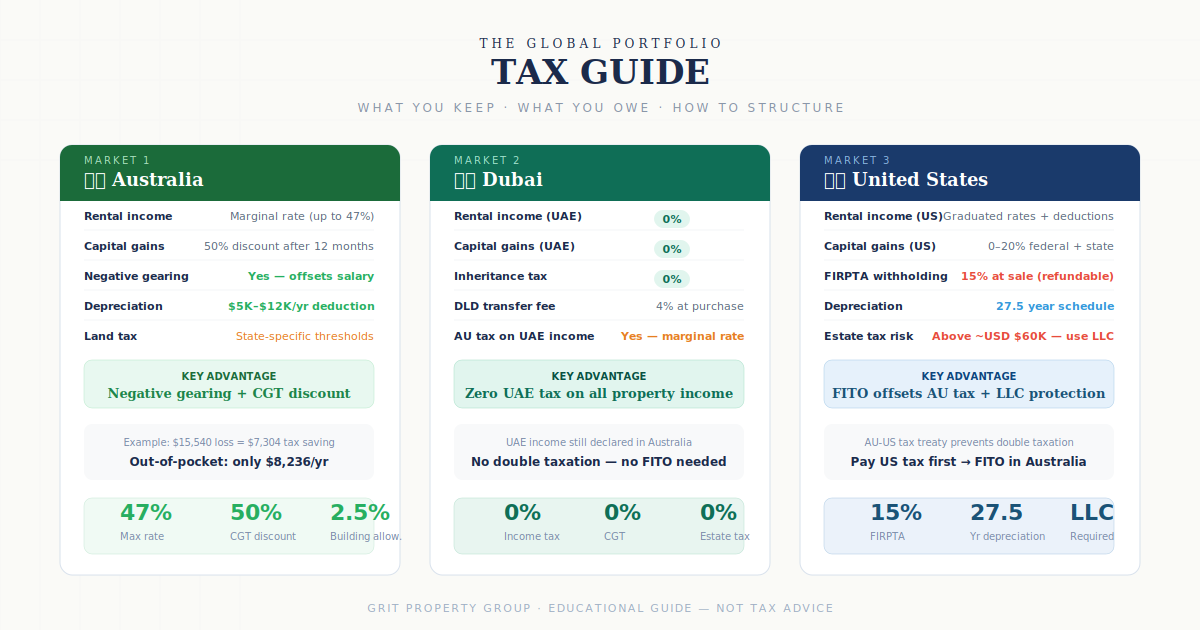
Tax is not an afterthought. For global investors, it is a strategy.
The difference between a well-structured three-market portfolio and a poorly structured one is not always which properties you buy. It is often how you own them, where you report the income, and whether you have taken advantage of the legal structures available in each jurisdiction.
This guide covers the tax treatment of property investment across Australia, Dubai, and the United States — from rental income and capital gains through to foreign income disclosure obligations and the interaction between tax systems.
Australia — tax treatment overview
Australia has one of the most investor-friendly tax systems for property — not because rates are low, but because the rules allow investors to offset property losses against other income, and because capital gains receive a significant discount for long-term holders.
| Tax type | How it works | Investor implication |
|---|---|---|
| Rental income | Taxed at your marginal rate (up to 47% including Medicare levy) | High earners pay more tax on rental income — but also get a larger negative gearing benefit |
| Negative gearing | When deductible expenses exceed rental income, the net loss offsets your other taxable income (salary, business) | A $10,000 annual loss saves a top-bracket earner ~$4,700 in income tax per year |
| Capital gains tax | Properties held 12+ months receive a 50% CGT discount. Net gain added to income at marginal rate | A $200K capital gain held 3+ years adds $100K to your taxable income — not $200K |
| Depreciation | Building allowance (2.5% p.a.) and plant & equipment depreciation available | A quantity surveyor schedule can generate $5,000–$12,000 in annual deductions on a new property |
| Land tax | Levied annually on unimproved investment land above state-specific thresholds | Portfolio across multiple states can trigger multiple land tax obligations |
| Foreign income | AU residents must declare all worldwide income including Dubai and US properties | Foreign tax credits may apply to reduce double taxation |
The negative gearing arithmetic — a worked example
| Annual rental income | $26,000 |
| Mortgage interest | −$28,500 |
| Property management fees | −$2,340 |
| Rates, insurance, maintenance | −$3,200 |
| Depreciation (QS schedule) | −$7,500 |
| Total deductible expenses | −$41,540 |
| Net property loss | −$15,540 |
| Tax saving (at 47% marginal rate) | $7,304 per year |
The bottom line: The property costs $15,540 on paper but only $8,236 out of pocket after tax. The equity and capital growth are building on the full asset value.
Dubai — tax treatment overview
Dubai's tax environment is the simplest of the three markets: no income tax, no capital gains tax, and no inheritance tax on UAE property. For Australian investors, this creates a genuinely tax-free income stream — subject to Australian foreign income disclosure obligations.
| Tax type | Dubai treatment | Australian treatment |
|---|---|---|
| Rental income | 0% — no income tax in UAE | Must be declared in Australia as foreign income and taxed at your marginal rate |
| Capital gains | 0% | Assessable in Australia — 50% CGT discount applies if held 12+ months |
| VAT | 5% VAT on commercial property and some fees. Residential generally exempt | Not applicable to Australian tax return |
| DLD transfer fee | 4% Dubai Land Department fee on purchase price | Not a tax — a transaction cost. Factor into entry cost calculations |
| Inheritance | No inheritance tax in UAE | Australian estate planning rules apply to overseas assets |
Key implication: Dubai rental income is not tax-free for Australians. It is UAE-tax-free — but it must be declared in Australia and taxed at your marginal rate. For high-income earners, this means up to 47%. The 8–12% gross yield still typically delivers a strong net return — but model the after-tax number, not the headline yield.
United States — tax treatment overview
The US tax system is the most complex of the three markets. The US taxes non-resident aliens on US-sourced income, which means Australian investors have both US and Australian tax obligations — managed through the Australia-US tax treaty to avoid double taxation.
| Tax type | US treatment | Australian treatment |
|---|---|---|
| Rental income | Non-resident aliens taxed at 30% flat rate unless they elect to treat income as effectively connected — which reduces rate to graduated rates with deductions | Must also be declared in Australia; FITO for US tax paid reduces AU liability |
| Capital gains | Federal: 0%, 15%, or 20% depending on income. State: varies (0–13%) | AU CGT also applies — 50% discount for 12+ month hold. FITO offsets AU liability |
| FIRPTA | 15% of gross sale price withheld at settlement for non-residents. Refundable via US tax return if actual liability is lower | A cashflow consideration at sale — not a permanent cost, but requires a US tax return |
| Depreciation | Residential property depreciated over 27.5 years. Significant deduction available | Reduces US taxable income but creates a depreciation recapture liability at sale (taxed at 25%) |
| LLC pass-through | Single foreign owner LLC = disregarded entity. Income flows to owner's return | LLC income still assessable in Australia; structure affects asset protection, not necessarily tax rate |
| Estate tax | Non-residents subject to US estate tax on US assets above ~USD $60,000 | An LLC or appropriate trust structure can shelter US property — critical for Australian investors |
🔍 FIRPTA — what every Australian buyer needs to know
When a non-resident sells US property, the buyer withholds 15% of the gross sale price and remits it to the IRS. If your actual tax liability is less than the 15% withheld — which it often is — you reclaim the difference via a US tax return. This is not a cost. It is a timing issue. But it means you need a US tax advisor and must file a US return in the year of sale.
The Australia-US tax treaty: In practice, Australian investors pay US tax first on US-sourced income, then claim a foreign income tax offset (FITO) in Australia — reducing or eliminating the additional Australian tax on the same income. No genuine double taxation.
The interaction between tax systems
How the three tax jurisdictions work together for an Australian resident investor.
| Scenario | Tax position |
|---|---|
|
🇦🇺 AU property, AU resident |
Income taxed at AU marginal rate. CGT with 50% discount. Negative gearing offsets other income. |
|
🇦🇪 Dubai property, AU resident |
No UAE tax. Income taxed in Australia at marginal rate. CGT in Australia with 50% discount. No double taxation. |
|
🇺🇸 US property, AU resident (via LLC) |
Income taxed in US first (graduated rates with deductions). FITO offsets AU liability. CGT in both jurisdictions — FITO applies. |
|
🌏 All three markets, AU resident |
Three income streams, three CGT exposures. Tax treaty and FITO frameworks manage double taxation. Correct structure in each market is essential. |
This is where structure matters most. The right ownership structure in each market — trust, LLC, company, or personal name — changes your tax position, your asset protection, and your estate planning outcome.
Get your tax position modelled before you invest
GRIT works with specialist cross-border accountants who understand the interaction between Australian, UAE, and US tax obligations. Your Strategy Session can include a referral to the right advisor for your situation.
Book Free Strategy Session →"The truth will set you free."
GRIT Property Group │ Melbourne · Dubai · New York