
The First-Time Investor Checklist
27 checks before your first investment property — so you walk in prepared, not guessing.
GRIT Property Group
Melbourne · Dubai · New York
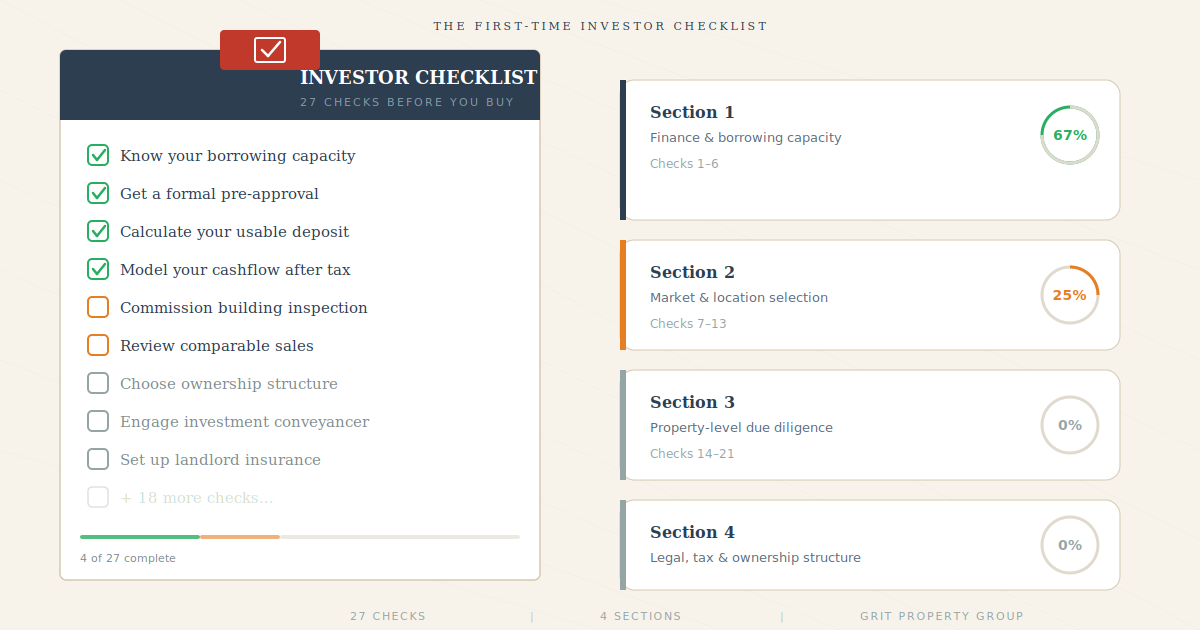
Start right. The rest follows.
The biggest advantage an experienced investor has over a first-time investor is not money, connections, or access to better properties. It is preparation. They know what questions to ask, what to look for in the numbers, and what documents to have ready before they make an offer.
This checklist is designed to give you that same preparation before your first purchase. Work through it in order. If any item raises a question you can't answer, that's where to focus before you proceed.
🖨️ Print it. Use it. Your future self will thank you.
Finance & borrowing capacity
Complete this section before you look at a single property.
Knowing your numbers prevents you from falling in love with something you can't finance.
Know your borrowing capacity
Speak to a mortgage broker — not just your bank — and get a formal borrowing capacity assessment. Your bank will only show you their products; a broker compares across 20–30 lenders.
Get a formal pre-approval
A pre-approval is not the same as a borrowing capacity assessment. A formal pre-approval means a lender has reviewed your financials and confirmed they will lend up to a specified amount, subject to property valuation.
Calculate your usable deposit
Your deposit is not just your savings. It may include equity in your home, a family guarantee, or superannuation (via SMSF). Calculate the total figure across all sources, then subtract the buffer you must keep liquid.
Understand Lenders Mortgage Insurance (LMI)
If your deposit is less than 20% of the purchase price, most lenders will charge LMI — a one-off premium that protects the lender, not you. Know what it will cost and factor it into your budget.
Account for purchase costs
Stamp duty, conveyancing, building and pest inspection, loan establishment fees, and landlord insurance can add 4–6% to the purchase price. Calculate the full cost of entry, not just the deposit.
Model your cashflow after tax
Ask your accountant to model the net cashflow position — rental income minus mortgage, rates, insurance, management fees, and maintenance — adjusted for your marginal tax rate and negative gearing benefit. Know the number before you commit.
Market & location selection
The highest-leverage decision in property investing.
The right property in the wrong location will underperform for a decade.
Define your investment goal
Are you optimising for capital growth, rental yield, tax minimisation, or cashflow? The answer changes which market, which suburb, and which property type is right for you. Write it down before you start looking.
Identify your target market
Based on your goal and your borrowing capacity, which market makes sense — Australian H&L package, established apartment, interstate growth corridor, or international? Don't default to your home city because it's familiar.
Check the infrastructure pipeline
Research committed government spend within a 5km radius of your target suburb — transport, schools, hospitals, employment precincts. Infrastructure spend is the most reliable leading indicator of capital growth.
Verify rental vacancy rates
A vacancy rate below 2% indicates strong rental demand. Above 3% indicates oversupply risk. Check the current vacancy rate via SQM Research or your property manager's local data.
Review 10-year median price history
A suburb's track record is not a guarantee of future performance — but it tells you whether the fundamentals have historically delivered. Avoid suburbs with flat or declining 10-year medians unless you have a specific thesis.
Understand supply risk
Check development approvals and new supply coming to market. A suburb with strong demand but a large pipeline of new apartments can see yields compressed and resale values suppressed for years.
Visit the area in person
Google Maps is not due diligence. Walk the streets. Visit on a weekday and a weekend. Check proximity to transport, retail, schools, and employment. Talk to locals. A 30-minute visit will tell you things no data set will.
Property-level due diligence
Where many first-time investors cut corners — and where the most costly mistakes are made.
Commission a building and pest inspection
A qualified inspector will identify structural issues, water damage, pest activity, and non-compliant building work invisible to the untrained eye. Cost: $400–$700. Potential saving: tens of thousands.
Review the strata report (if applicable)
For apartments and townhouses, look for: outstanding levies, planned major works (roof, lifts, common areas), litigation history, and the balance of the sinking fund. A depleted sinking fund means a special levy is coming.
Verify the rental appraisal independently
The selling agent's rental estimate is not independent. Obtain a rental appraisal from a property manager who operates in that suburb and has no relationship to the sale.
Check council zoning and overlays
Verify the property's zoning and any overlays — heritage, flood, bushfire, development restrictions — through the local council or state planning portal.
Review comparable sales
Look at what similar properties in the same street or suburb have sold for in the past 6–12 months. If the asking price is significantly above comparable sales, you need a compelling reason — or a lower offer.
Understand the depreciation schedule
A depreciation schedule, prepared by a qualified quantity surveyor, identifies the tax-deductible depreciation available. For newer properties, this can be worth $3,000–$8,000 in tax deductions per year. Commission one at settlement.
Assess property management options
Identify two or three property management companies in the area. Compare their fees (typically 7–10% of rent), vacancy rates, tenant screening process, and owner reporting frequency. The wrong property manager is expensive.
Understand ongoing holding costs
Calculate the full annual cost of ownership: mortgage repayments, council rates, water rates, landlord insurance, property management fees, maintenance reserve, and body corporate levies if applicable.
Legal, tax & ownership structure
Get advice before you sign — not after. The wrong structure is expensive to undo.
Choose the right ownership structure
Personal name, joint names, family trust, company, or SMSF — each has different tax treatment, asset protection, and borrowing implications. Speak to your accountant and solicitor before you decide.
Understand land tax in your state
Land tax is levied on the unimproved value of investment land above a threshold that varies by state. If you already own investment property, a new purchase may push you into a higher bracket.
Engage an investment-savvy conveyancer or solicitor
Not all conveyancers are equal. Engage one who regularly works with investors, understands the specifics of your purchase type, and will flag any issues in the contract before you sign.
Review the contract of sale carefully
Read every clause. Key items: settlement period, deposit amount and terms, inclusions and exclusions, sunset clause (if off-the-plan), special conditions, and cooling-off rights in your state.
Set up landlord insurance before settlement
Landlord insurance is different from standard building and contents insurance. It covers loss of rent, tenant damage, and legal liability specific to investment properties. Have it in place from day one.
Prepare your tax records from day one
Keep every receipt, every invoice, every statement from the day you settle. Loan interest, property management fees, repairs, depreciation, and borrowing costs are all potentially deductible. A shoebox of receipts is not a tax record — use accounting software or engage a property-savvy accountant.
Want someone to walk through this with you?
A GRIT Strategy Session is 60 minutes with an Investment Strategist who has worked through this checklist with hundreds of clients.
We'll review your financial position, identify the right market and property type for your situation, and present a written strategy. It's free.
Book Free Discovery Session →"The truth will set you free."
GRIT Property Group │ Melbourne · Dubai · New York