
Negative gearing in Australia is one of the most talked about strategies in property, yet most investors misunderstand it completely. This guide explains how negative gearing in Australia works in 2026, what it genuinely costs you, and when it makes sense. We will also cover the bigger mistake that quietly destroys returns.
What negative gearing in Australia actually means
A property is negatively geared when your expenses exceed your rental income. In other words, you make a loss on paper. That loss can then reduce your taxable income.
Expenses include loan interest, council rates, insurance, management fees, and repairs. Depreciation counts too, and it matters more than most people realise.
A simple worked example
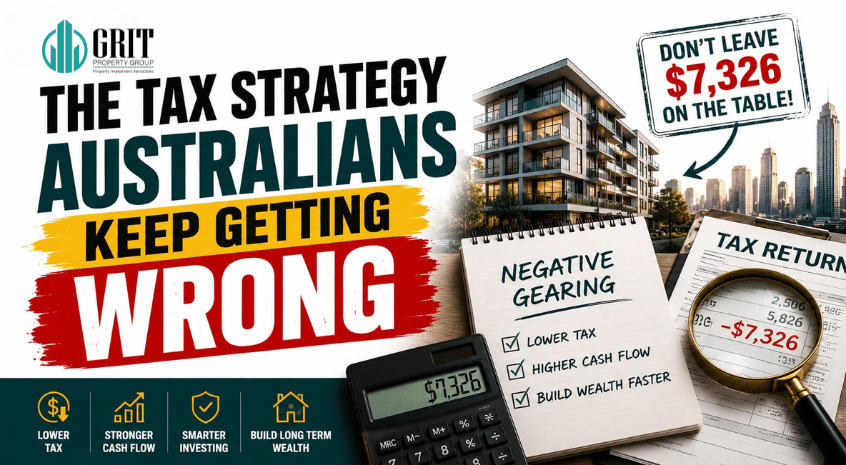
Imagine an investment property worth $700,000. Say it produces a tax loss of roughly $19,800 in a year. At a 37% tax rate, that loss returns about $7,326 to you as a refund.
Now multiply that across three similar properties. Suddenly you are receiving close to $21,978 back each year. Meanwhile, you control $2.1 million in Australian real estate.
After rent and after your refund, the weekly out of pocket cost can land near $150. That is less than many families spend on one dinner out.
Why depreciation is the quiet hero
Depreciation is a deduction you claim without spending cash each year. The building and its fittings lose value over time, and the tax system recognises that.
As a result, depreciation often turns a small cash loss into a much larger tax loss. Many investors never claim it properly, so they hand money back to the tax office for no reason.
The Australian Taxation Office publishes what you can and cannot claim on rental properties. Always confirm current rules there, because deduction categories do change.
The mistake that costs investors the most
Here is the principle worth writing down. Do not invest for tax. Invest for income.
Negative gearing in Australia is a bonus, not a strategy. Buying a poor asset simply to claim a loss is still losing money. You cannot deduct your way to wealth.
Instead, buy assets that grow and eventually pay you. Then let the tax treatment improve your cash flow while you hold them.
Negative gearing versus positive cash flow
Australian investors often argue about which approach wins. In practice, the smart answer is both, in different markets.
- Negatively geared Australian property gives you growth plus annual tax refunds.
- Positive cash flow property overseas gives you monthly income without the tax drag.
- Together, the refund and the income can fund your next deposit faster.
So the two strategies are not enemies. Rather, they solve different problems inside one portfolio.
When negative gearing in Australia stops working
Negative gearing in Australia depends on having income to offset. If your income drops, the benefit shrinks quickly.
It also assumes you can comfortably fund the shortfall each month. Therefore, buffer planning matters more than the refund itself. Investors who overextend get forced to sell at the worst possible time.
How it connects to your bigger strategy
Negative gearing in Australia works best inside a plan, not on its own. Our article on The Tax Strategy Costing Australians $20,000 Every Single Year covers the deductions most people miss. If you want the tax free version of long term growth, read SMSF Property Investment in Australia next, because super changes the maths considerably.
What you can and cannot claim
Investors often guess here, and guessing is expensive. Keep the categories clear in your mind.
- Loan interest on the investment portion of the debt.
- Property management fees and letting costs.
- Council rates, water charges, and landlord insurance.
- Repairs that restore the property to its original condition.
- Depreciation on the building and on eligible fittings.
However, improvements work differently from repairs. Replacing a broken tap is a repair. Renovating the entire bathroom is an improvement, so it gets treated as capital instead.
Why a depreciation schedule pays for itself
A quantity surveyor prepares a depreciation schedule for your property. It lists every claimable item and its annual value.
The report costs a few hundred dollars. Meanwhile, it frequently unlocks thousands in deductions each year, and the fee itself is deductible.
Newer properties generally produce larger depreciation claims, because the building and fittings are closer to their original value. Therefore, property age directly affects your after tax position.
How negative gearing in Australia changes as the loan shrinks
Here is something few investors plan for. Negative gearing in Australia is temporary by design.
As rents rise and your loan reduces, the property eventually turns positive. At that point, you start paying tax on the income instead of claiming a loss.
So the strategy has a natural life cycle. First it shelters income, then it produces income. Both stages are good outcomes, provided you saw them coming.
Who negative gearing in Australia genuinely suits
- Investors on higher marginal tax rates, where deductions carry more value.
- People with stable employment income and a solid cash buffer.
- Buyers focused on capital growth over immediate yield.
- Investors with a holding horizon measured in decades, not years.
Conversely, it suits retirees and low income earners far less. With little taxable income to offset, the deduction simply does not do much work.
The ownership structure question
Whose name should hold the property? This decision affects your deductions permanently, and changing it later is costly.
Holding in the higher earner’s name maximises the deduction while the property runs at a loss. However, that same structure means more tax when the property turns positive or gets sold.
Consequently, structure should follow your long term plan rather than this year’s refund. Always take proper advice before signing contracts.
The problem most Australians actually have
Very few investors lack information. They lack a coordinated plan. One property sits negatively geared, another sits idle, and nothing connects them.
Consequently, their portfolio grows slowly and unpredictably. They pay more tax than needed and still feel stuck.
Cash flow versus tax refund timing
Here is a practical detail investors overlook. Your shortfall is paid monthly, but your refund usually arrives once a year.
So you fund the gap for twelve months before the money comes back. That timing mismatch strains household budgets more than the annual figures suggest.
There is a solution, though. You can apply to have your tax withheld at a reduced rate during the year. As a result, the benefit arrives in your pay rather than in one lump sum.
What happens when you sell
Capital gains tax applies when you sell an investment property. However, holding the asset for more than twelve months generally reduces the taxable gain considerably.
This is why patient investors do so well. Every year you hold, the tenant reduces your loan, and the market does its work.
The strongest capital gains strategy remains the simplest one. Do not sell unnecessarily, because you cannot be taxed on a gain you never realised.
Negative gearing is not a strategy on its own
Let us restate the central point clearly. Negative gearing improves the maths on a good asset. It cannot rescue a bad one.
A property in a weak location with flat growth still loses money, refund or not. Meanwhile, you have tied up your borrowing capacity for years.
Therefore, judge every purchase on rental demand, supply, and growth drivers first. Treat negative gearing as the final adjustment, never the opening argument.
Key takeaways
Before you act on any of this, hold on to the core points. They matter more than the finer detail.
- Negative gearing in Australia reduces your holding cost. It does not generate profit on its own.
- Depreciation is the deduction most investors underclaim, so get a proper schedule.
- Buy for income and growth first, then let the tax treatment improve the numbers.
- Expect the property to turn positive eventually, and plan for that shift.
- Ownership structure affects your deductions permanently, so decide it deliberately.
In short, treat the refund as a bonus on a good decision. It can never rescue a poor one.
Frequently asked questions
Is negative gearing in Australia still allowed in 2026?
Yes. Investors can still offset rental losses against other income under current rules. Policy debate continues, so keep an eye on announcements each budget cycle.
Does negative gearing actually make me money?
Not on its own. It reduces the cost of holding a property. Your profit comes from capital growth and rising rents over time, not from the deduction itself.
Can I claim negative gearing on an overseas property?
Australian residents generally declare foreign rental income and can claim related expenses. The rules are detailed, so confirm your position with a qualified tax professional.
How long should I expect a property to stay negatively geared?
Commonly several years. As rent rises and the loan reduces, most properties eventually turn positive. That transition is a good outcome, not a problem.
Is a depreciation schedule worth the cost?
For most investment properties, comfortably yes. The report usually unlocks far more in deductions than it costs, and the fee itself is deductible.
How Grit Global Membership helps
Membership gives you a one on one portfolio strategy review, so your existing assets and your next purchase finally work together. You also get monthly masterclasses and private investor deals across Australia, Dubai, and the United States.
This article is educational only. It is not financial, tax, or legal advice, so always get personal advice for your circumstances.
👉 Join the Grit Global Membership and book your free strategy session here
Negative gearing in Australia can absolutely help you. Just make sure it is the bonus on a good asset, never the reason you bought it.