
How to Use Equity to Fund Your Next Property Purchase
The strategy that turns one property into a portfolio — without waiting years to save another deposit.
GRIT Property Group
Melbourne · Dubai · New York
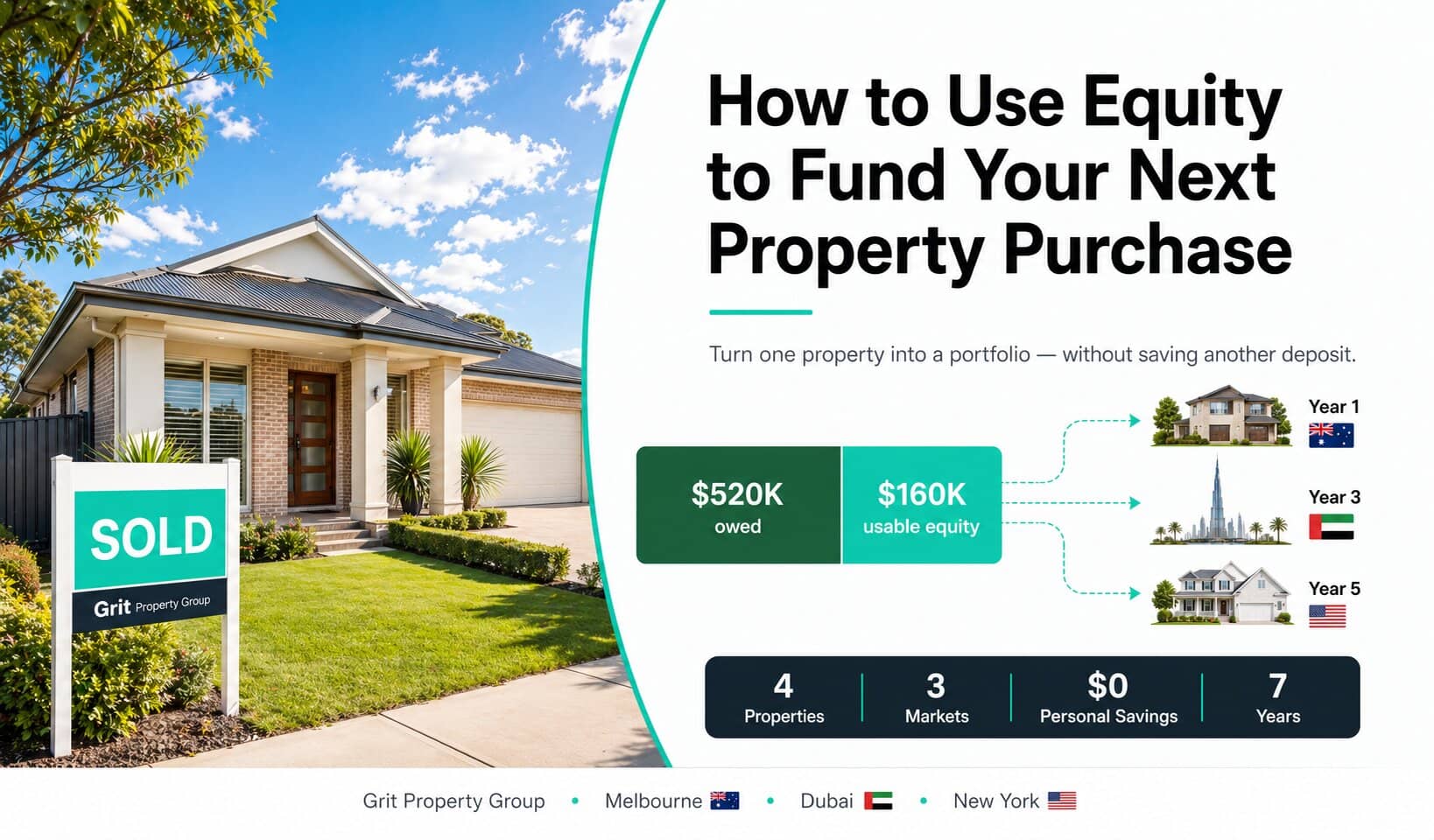
The investors who build portfolios fastest are rarely the ones who save the hardest. They are the ones who understand equity.
Most Australians buy their first investment property, hold it, watch it grow, and then wait. They wait until they have saved another deposit. They wait until the mortgage feels smaller. They wait until it feels safe to move again.
The investors who build three, five, or ten-property portfolios do something different. They understand that the equity accumulating inside their existing properties is deployable capital — and they deploy it, systematically and deliberately, into the next purchase.
This guide explains how equity works, how to access it, how much you can realistically use, and how GRIT clients use it to enter new markets — including Dubai and the United States — without touching their savings.
What equity is — and what it isn't
Equity is the difference between what a property is worth and what you owe on it.
| Current market value of your property | $850,000 |
| Outstanding mortgage balance | −$520,000 |
| Total equity | $330,000 |
But total equity is not the same as usable equity. Lenders apply a loan-to-value ratio (LVR) cap, typically 80%, to protect against price fluctuations.
| Usable equity calculation | |
|---|---|
| Current market value | $850,000 |
| 80% LVR cap | $680,000 |
| Outstanding mortgage balance | −$520,000 |
| Usable equity | $160,000 |
In this example, the investor has $330,000 in total equity but only $160,000 they can realistically access without paying LMI. That $160,000 is the number that matters.
How to access equity — the three main methods
How much equity do you need to enter each market?
| Market | Deposit requirement | Usable equity needed | Notes |
|---|---|---|---|
| 🇦🇺 Australia (H&L) | 10–20% of land + construction | $50K–$120K | Standard AU mortgage; LMI below 20% |
| 🇦🇪 Dubai (off-plan) | 10–25% via developer plan | $30K–$100K AUD | Remaining payments spread over construction |
| 🇺🇸 United States | 25–30% DSCR loan; 100% cash | $100K–$180K AUD | US lenders don't accept AU property as security |
For Dubai and US entry: Australian lenders cannot take security over overseas property. You must draw equity as cash first via equity release or LOC, then transfer funds to the relevant jurisdiction. Straightforward — but requires planning ahead of exchange.
The equity compounding model — a worked example
How a GRIT client builds a three-market portfolio using equity as the engine.
Year 0 — Starting position
Owner-occupier home purchased for $700K, now worth $900K, $480K owing
→ $240K usable equity available
Year 1
Use $100K deposit → first AU H&L package ($550K)
Year 3
AU property #1 grown to $620K → access $96K new equity → use $75K for Dubai off-plan
Year 5
Home equity grown further → draw $140K cash → 30% deposit on US Sun Belt rental (USD $380K)
Year 7
AU property #1 equity now ~$180K usable → purchase AU investment property #2
Portfolio at Year 7
4
Properties
3
Markets
~$0
Personal savings used
Simplified illustration. Actual outcomes depend on market performance, borrowing capacity, and individual circumstances.
The equity readiness checklist
Before approaching a lender to access equity, confirm the following:
Property valued in the last 12 months
Lender will order their own valuation — knowing the likely outcome prevents surprises.
Income and employment position unchanged
A change in employment or income can affect your ability to service additional debt.
Modelled the increased repayments
Drawing equity increases your loan balance and your repayments — before any new property costs.
Identified the specific use for the equity
Equity sitting idle costs interest from day one. Have the next purchase ready.
Spoken to a mortgage broker, not just your existing lender
Your existing lender may not offer the most competitive equity release product.
Understand the tax treatment of drawn equity
Equity used for investment is typically tax-deductible. Equity for personal use is not. Mixing creates accounting complexity.
The GRIT view on equity
Equity is not wealth — it is potential. It becomes wealth when it is deployed into assets that compound faster than the interest cost of accessing it.
A property growing at 6% in a corridor with committed infrastructure — with depreciation benefits and negative gearing offsetting holding costs — is a fundamentally different calculation than a borderline yield play. Equity strategy is inseparable from property selection. Which is why GRIT addresses both in the same session.
Find out how much equity you can access — and where to deploy it
A GRIT Strategy Session will calculate your usable equity position, model your borrowing capacity for the next purchase, and identify which market makes the best use of what you have available.
Book Free Discovery Session →"The truth will set you free."
GRIT Property Group │ Melbourne · Dubai · New York